

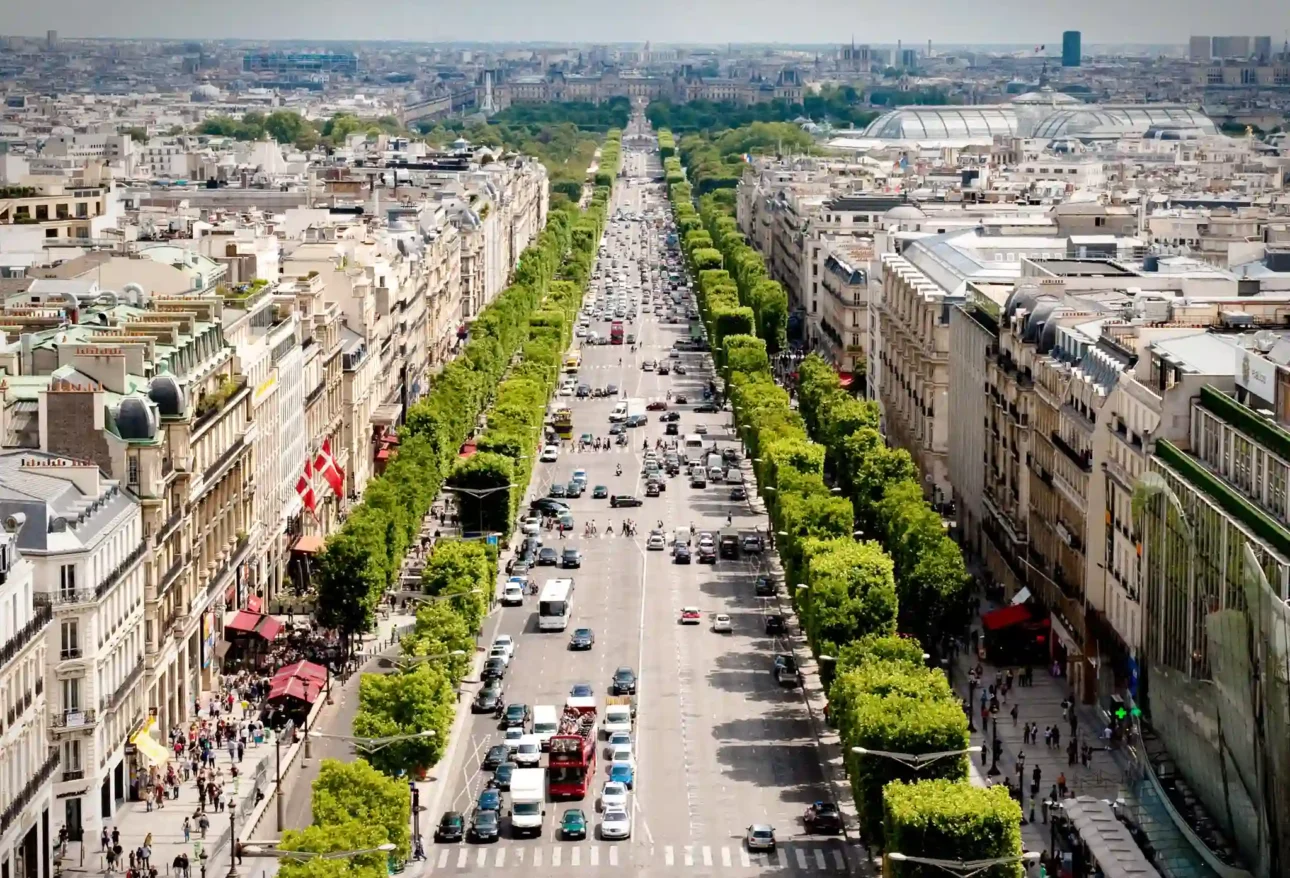
There’s a reason the French call it la plus belle avenue du monde – “the most beautiful avenue in the world.” Stretching in an arrow-straight line between two of Paris’s most photographed landmarks, the Champs-Élysées is where the city puts on its finest show: chestnut trees, flagship fashion houses, grand café terraces, and, rising at its western end, one of the most recognizable monuments on the planet.
If you’re planning a trip to Paris, the Champs-Élysées deserves more than a rushed photo stop. This avenue has hosted coronation processions, liberation parades, Tour de France finishes, and New Year’s Eve fireworks watched by millions. It has survived four centuries of Parisian history and come out the other side as the city’s grandest stage.
In this guide, we’ll walk you through everything worth knowing about the Champs-Élysées: where it came from, what to see and do along its 1.9 kilometers, the full story of the Arc de Triomphe standing at its edge, and – because this avenue sits at the literal center of tourist Paris – just how easily you can combine it with some of the city’s other unmissable sights, many of them only minutes away.
Champs-Élysées at a Glance
| Length | 1.9 km (1.2 miles) |
| Location | 8th arrondissement, Paris |
| Connects | Place de la Concorde ↔ Place Charles de Gaulle (Arc de Triomphe) |
| Nearest Metro | Charles de Gaulle–Étoile, George V, Franklin D. Roosevelt, Champs-Élysées–Clemenceau |
| Daily Visitors | Around 300,000 |
| Top Landmark | Arc de Triomphe |
| Best For | Shopping, people-watching, iconic photos, Paris’s biggest celebrations |
What Makes the Champs-Élysées So Special?
Ask ten Parisians what the Champs-Élysées means to them and you’ll get ten different answers. For some, it’s the ultimate shopping destination – a 1.9-kilometer stretch of flagship stores where a single window display can take up half a block. For others, it’s the site of the country’s biggest public moments: the military parade every Bastille Day, the finish line of the Tour de France since 1975, the wall-to-wall crowds on the night France wins a major title.
For visitors, it’s often simpler than that: it’s the postcard image of Paris come to life. Walk from the Place de la Concorde toward the Arc de Triomphe and the avenue rises gently ahead of you, framed by uniform Haussmann-era façades, with the arch growing larger with every block until it fills the horizon. Few streets anywhere manage to feel both grand and genuinely alive – full of locals commuting, tourists snapping photos, and everyone in between.
A Brief History of the Champs-Élysées
The Champs-Élysées has been evolving for over four centuries. In 1616, Queen Marie de’ Medici ordered a tree-lined carriage path cleared through open fields and marshland west of the Tuileries Palace – at the time, well outside the city itself. Decades later, André Le Nôtre, the landscape architect behind the gardens of Versailles, extended and formalized the avenue as part of his redesign of the Tuileries. It was Le Nôtre’s vision – long, wide, and perfectly straight – that gave the avenue its enduring character.
The name “Champs-Élysées” was adopted in 1709, borrowed from Greek mythology’s Elysian Fields, the paradise where heroes and the virtuous were said to rest after death. In 1724, the avenue was extended further west, roughly to where the Arc de Triomphe stands today, giving it close to its modern length and route.
Through the 18th century, the Champs-Élysées grew fashionable as grand townhouses and landscaped gardens sprang up nearby, including the grounds of what is now the Élysée Palace, home to the President of France. In 1806, Napoleon commissioned a triumphal arch to crown the avenue’s western end in honor of his military victories; construction dragged on through political upheaval and wasn’t completed until 1836 – the Arc de Triomphe we know today.
The avenue reached its golden age in the late 19th and early 20th centuries. The 1900 Exposition Universelle (World’s Fair) brought over 50 million visitors to Paris and left behind two of the Champs-Élysées’ most beautiful buildings: the glass-roofed Grand Palais and its smaller neighbor, the Petit Palais, both still standing near the Place de la Concorde end of the avenue.
The 20th century turned the Champs-Élysées into a stage for national memory. French troops marched down it after the liberation of Paris in 1944. It has been the finish line of the Tour de France every year since 1975. And every July 14th, Bastille Day, it hosts France’s national military parade – one of the largest of its kind in Europe. Today, the avenue remains what it has been for over a century: the place Paris – and France – gathers to celebrate, commemorate, and be seen.
The Arc de Triomphe: The Crown Jewel of the Champs-Élysées
No visit to the Champs-Élysées is complete without the Arc de Triomphe, the monument that anchors the entire avenue and arguably outshines it. Standing at the Place Charles de Gaulle (still widely called Place de l’Étoile, “Square of the Star,” for the twelve avenues that radiate from it), the arch has watched over the western end of the Champs-Élysées since 1836.
Napoleon commissioned the monument in 1806 to honor the French armies, modeling it on the triumphal arches of ancient Rome. Construction spanned three decades and outlived Napoleon himself – he never saw it finished. Once complete, it quickly became one of the most important monuments in France: its stone friezes depict scenes from the Napoleonic Wars, and the names of nearly 600 French generals are engraved along its inner walls.
At the base of the arch lies the Tomb of the Unknown Soldier, marked by an eternal flame that has burned continuously since 1923 in memory of France’s fallen soldiers from the First World War. This part of the monument is free to visit and accessible at ground level at any time – one of the few genuinely free experiences on the entire avenue.
For most visitors, though, the real draw is above. A staircase of 284 steps (with an elevator available for visitors with reduced mobility) leads up to a small museum and, beyond it, a panoramic terrace roughly 50 meters above street level. From here, you get one of the best views in Paris: the Champs-Élysées laid out beneath you in one direction, and in the other, the twelve avenues of the Étoile fanning out like the points of a star, with the Eiffel Tower, Sacré-Cœur, and the skyscrapers of La Défense all visible on a clear day.
Visiting hours and tickets: The Arc de Triomphe’s rooftop is open daily, typically from 10:00 AM to 11:00 PM between April and September, and 10:00 AM to 10:30 PM the rest of the year (last entry is always 45 minutes before closing). It closes for part of the morning on a handful of French holidays, including May 1st, May 8th, July 14th, and November 11th, and can close on short notice for official ceremonies. Ticket prices vary seasonally, generally between €16 and €22 for adults, with free entry for under-18s and for 18–25-year-old EU residents.
Because it’s one of the most visited monuments in Paris, lines can build quickly, especially around midday in summer. Booking ahead is the easiest way around this — programtickets.com offers both skip-the-line Arc de Triomphe rooftop tickets with an English audio guide for visitors who want to explore independently, and a private guided Arc de Triomphe tour for those who’d rather have a local expert bring the monument’s history to life in person.
Top Things to Do Along the Champs-Élysées
Shop Like a Parisian
The Champs-Élysées has ranked among the world’s most expensive retail streets for years – currently the fifth most expensive in the world, right behind New York’s Fifth Avenue and London’s New Bond Street. Flagship stores line both sides of the avenue, from Louis Vuitton’s multi-floor showcase to Galeries Lafayette’s striking Art Déco building, which opened its Champs-Élysées location in 2019 and includes a food court in the basement worth a visit on its own. A few steps off the main avenue, Avenue Montaigne – the heart of Paris’s “Golden Triangle” – adds Dior, Chanel, and a roster of equally famous names for anyone chasing high fashion.
Take a Seat at a Grand Café
Not every part of the Champs-Élysées experience needs a receipt to remember it by. The avenue is lined with café terraces perfect for people-watching, and a handful of institutions are worth seeking out specifically. Fouquet’s, open on the avenue for more than 120 years, remains one of Paris’s most storied brasseries and a longtime favorite with French celebrities and politicians. For something sweeter, Ladurée’s flagship tea room serves its famous macarons in a setting as elegant as the pastries themselves. And for a splurge, several Michelin-starred addresses – including Pavillon Ledoyen, helmed by three-star chef Yannick Alléno – sit just off the avenue in the surrounding gardens.
Step Inside the Grand Palais and Petit Palais
Built for the 1900 Exposition Universelle and still among the most beautiful buildings in Paris, the Grand Palais and Petit Palais sit side by side near the Place de la Concorde end of the avenue. The Grand Palais, famous for its enormous glass-and-steel dome, hosts major art exhibitions and cultural events throughout the year. Its smaller sibling, the Petit Palais, houses the City of Paris’s fine arts museum – and unlike most major Paris museums, entry to its permanent collection is free. Even if you don’t step inside either building, they’re worth a slow walk-past; the architecture alone is a highlight of the avenue.
Catch a Show
As evening falls, the Champs-Élysées shifts into entertainment mode. The Lido de Paris, one of the city’s legendary cabarets, has been staging elaborate shows with its signature feathered costumes for decades. The avenue and surrounding streets are also dotted with cinemas, including some of the grand old movie palaces that once made this stretch of Paris the country’s premiere destination for film premieres – a tradition that continues with red-carpet screenings held here throughout the year.
Best Time to Visit the Champs-Élysées
The Champs-Élysées is a year-round destination, but when you visit changes the experience considerably. Late spring and early autumn (May–June and September–October) bring mild weather and more manageable crowds, especially on weekday mornings before the tour buses arrive. Summer is livelier but busier and hotter, and if you’re visiting in July, timing your trip around Bastille Day (July 14th) means you can catch France’s biggest military parade sweeping down the avenue — though expect road closures and heavier security in the days around it.
Winter has its own appeal. From late November through early January, the avenue’s chestnut trees are strung with hundreds of thousands of lights, turning the Champs-Élysées into one of the most photographed Christmas displays in Europe.
As for time of day, early morning offers the emptiest photos and softest light, while golden hour – roughly an hour before sunset – bathes the avenue and the Arc de Triomphe in warm light and draws a livelier crowd. If you want to see the arch illuminated against a dark sky, plan to be on the terrace around sunset and stay until after dark; the transition is one of the best free shows in Paris.
How to Get to the Champs-Élysées
The Champs-Élysées is one of the easiest places in Paris to reach, whichever way you’re coming from.
By metro: Line 1 is the most convenient option, running directly beneath the avenue with four stations: Charles de Gaulle–Étoile (at the Arc de Triomphe), George V, Franklin D. Roosevelt, and Champs-Élysées–Clemenceau (near the Grand Palais). Lines 9 and 13 also stop at Franklin D. Roosevelt, and the RER A stops at Charles de Gaulle–Étoile, making it easy to connect from other parts of the city.
By bus: Several RATP routes serve the avenue directly, including lines 22, 28, 32, 42, 52, 73, 80, and 93.
By bike: Vélib’ stations are dotted along the entire length of the avenue, making a bike a genuinely pleasant way to cover ground quickly outside of peak traffic hours.
On foot: Walking the full 1.9 kilometers from the Arc de Triomphe to the Place de la Concorde takes roughly 30 to 45 minutes at a steady pace – though most visitors take considerably longer once cafés, shop windows, and photo stops enter the picture.
One tip: during major events like Bastille Day or New Year’s Eve, expect temporary road and metro station closures around the avenue. Check ahead if you’re visiting on a major French holiday.
Easy Day Trips and Experiences Near the Champs-Élysées
One of the best things about the Champs-Élysées is where it sits: right at the historic heart of tourist Paris. Because of that, almost everything else on a typical Paris itinerary is a short walk, one metro line, or a quick boat ride away. Here’s how easily you can build out your day from the avenue – including a few ways to skip the lines while you’re at it.
The Arc de Triomphe – right there
You don’t need to go anywhere to start: the Arc de Triomphe sits at the western tip of the avenue itself. Skip the ticket queue with rooftop tickets and an audio guide, or dig deeper into its history with a private guided tour of the monument.
Place de la Concorde and the Seine – about 10 minutes on foot
Walk to the opposite end of the avenue and you’ll reach the Place de la Concorde, with its Egyptian obelisk and twin fountains. The riverbank is right there too, along with a boat dock just steps away – the starting point for the Best Seine River Cruise in Paris, a relaxed way to see Notre-Dame, the Musée d’Orsay, and the Eiffel Tower from the water. If you’d rather explore at your own pace, a 24-hour or 48-hour hop-on-hop-off river pass turns the Seine into your personal shuttle between riverside landmarks.
The Louvre – one metro line, no transfer
Board Line 1 at any of the four Champs-Élysées stations and ride it straight to Palais Royal–Musée du Louvre; no changes required, and the trip takes about 15 minutes. Skip the famously long lines and head straight for the world’s most famous painting with a Louvre Museum VIP Private Mona Lisa Tour.
Musée d’Orsay – just across the river
A short ride or a scenic walk from Place de la Concorde brings you to the Musée d’Orsay, home to one of the world’s great collections of Impressionist and Post-Impressionist masterpieces, housed inside a converted Belle Époque train station. A private guided tour is a great way to make sense of a collection this large in a couple of focused hours.
Notre-Dame and the Latin Quarter – a short ride away
Notre-Dame reopened to the public in December 2024 after its long restoration, and seeing it in person again is genuinely moving. Combine the cathedral with a wander through the Latin Quarter’s medieval streets on a private tour of the Latin Quarter and Notre-Dame (with an optional boat cruise add-on), or book a focused Notre-Dame historical guided tour.
Montmartre and Sacré-Cœur – one metro ride
Trade the avenue’s polish for Montmartre’s cobblestones and artist squares, capped by the white domes of Sacré-Cœur and one of the best skyline views in Paris. A private guided tour of Montmartre and Sacré-Cœur covers the neighborhood’s history and hidden corners that are easy to miss on your own.
The Eiffel Tower — about 15 to 20 minutes
From Charles de Gaulle–Étoile, the Eiffel Tower is roughly 2 kilometers away – an easy metro or taxi ride, or a scenic 30-minute walk down Avenue Kléber through the Trocadéro if you’re in the mood to stretch your legs.
A half-day trip to Versailles
A little further out but still an easy addition to a longer Paris stay, the Palace of Versailles is reachable by RER train in about 40 minutes. Whether you want full access to the palace’s State Apartments with a private Versailles tour and reserved entry, or you’re happy exploring the grounds with a simpler Versailles garden entry ticket, it’s one of the most rewarding day trips from central Paris.
Practical Tips for Visiting the Champs-Élysées
It’s busy, always. With around 300,000 visitors a day, the Champs-Élysées is rarely quiet. If you want emptier photos, aim for early morning, before 9 AM.
It’s touristy pricing, not local pricing. Cafés directly on the avenue charge a premium for the location. For a more affordable coffee or lunch, the side streets just off the Champs-Élysées offer the same neighborhood at a fraction of the cost.
Watch your belongings. Like any dense tourist area, pickpocketing happens, especially around the metro stations and busy crossings. Keep bags zipped and in front of you.
Dress up a little for the fancier addresses. Places like Fouquet’s and the Michelin-starred restaurants nearby generally expect smart-casual attire at minimum.
Bring comfortable shoes. Between the length of the avenue and the 284 steps at the Arc de Triomphe, this isn’t a day for new shoes.
Book ahead in peak season. The Arc de Triomphe and most major nearby attractions get busy from June through August and around the winter holidays. Booking tickets or tours online in advance saves real time.
Arriving from the airport? If you need a comfortable way to get from Charles de Gaulle, Orly, Beauvais, or Le Bourget straight to your hotel near the avenue, programtickets.com also arranges private airport transfers, so your trip to the Champs-Élysées can start the moment you land.
Frequently Asked Questions About the Champs-Élysées
How long does it take to walk the Champs-Élysées?
Walking the full 1.9 kilometers between the Arc de Triomphe and the Place de la Concorde takes about 30 to 45 minutes at a steady pace, without stopping. Most visitors take longer once shop windows, cafés, and photo breaks are factored in.
Is the Champs-Élysées worth visiting?
Yes – it’s one of the most historically significant and visually striking streets in the world, and it sits within easy reach of several other major Paris landmarks, making it a natural hub for a day of sightseeing rather than a detour.
What is the closest metro station to the Champs-Élysées?
Four Line 1 stations run directly along the avenue: Charles de Gaulle–Étoile (Arc de Triomphe), George V, Franklin D. Roosevelt, and Champs-Élysées–Clemenceau (Grand Palais).
Is the Arc de Triomphe free to visit?
The ground-level Tomb of the Unknown Soldier is free and always accessible. Climbing to the rooftop terrace requires a paid ticket, generally between €16 and €22 depending on the season, with free entry for under-18s and 18–25-year-old EU residents.
What’s the best time of day to photograph the Champs-Élysées?
Early morning offers the emptiest streets, while golden hour – roughly an hour before sunset – gives the avenue and the Arc de Triomphe their most flattering light.
Can you walk from the Champs-Élysées to the Eiffel Tower?
Yes, though it takes around 30 minutes on foot. Most visitors take the metro or a short taxi ride instead, to save time and energy for the rest of the day.
Final Thoughts: Is the Champs-Élysées Worth Visiting?
Few streets in the world carry the weight of history, glamour, and everyday life quite like the Champs-Élysées. It’s a shopping destination and a war memorial, a Bastille Day parade route and a quiet place for coffee, a straight line of pavement that somehow holds four centuries of Paris within it. Walk it once, from the Place de la Concorde to the foot of the Arc de Triomphe, and you’ll understand why the French still call it the most beautiful avenue in the world.
The best part is that you don’t have to choose between the Champs-Élysées and the rest of Paris – the Louvre, the Seine, Notre-Dame, and Montmartre are all within easy reach, and programtickets.com can help you skip the lines at nearly every stop along the way.
Ready to plan your visit? Browse all of our guided tours and skip-the-line tickets in Paris and build a day around the world’s most beautiful avenue.