

At the very center of Barcelona’s old town stands one of Europe’s most remarkable landmarks: the Gothic Quarter Barcelona cathedral. Rising above narrow medieval streets, this magnificent building has watched over the city for more than seven centuries. While Gaudí’s Sagrada Familia often steals the spotlight, the Gothic Quarter Barcelona cathedral offers something different, a breathtaking journey into the soul of the old city, where stone, legend, and faith come together in perfect harmony.
This guide takes a deep look at the fascinating history of the Gothic Quarter Barcelona cathedral, its stunning architecture, and the enchanting neighborhood that surrounds it, so you can fully appreciate why this landmark remains one of Barcelona’s most treasured monuments.
A Powerful History Written in Stone
Roman and Early Christian Origins
The story of the Gothic Quarter Barcelona cathedral begins long before its Gothic towers were ever built. The site has been a place of worship since the Roman era, when Barcelona was known as Barcino. Archaeological evidence suggests that an early Christian basilica once stood on this very spot, making it one of the oldest continuously sacred sites in the city.
By the 4th century, a paleo-Christian church already occupied part of the area, and remnants of this early structure can still be found beneath the current building. This deep historical foundation gives the cathedral a sense of continuity that few other monuments in Europe can claim. Visitors are not simply standing inside a medieval church; they are standing on ground that has been considered sacred for well over 1,600 years.
The Romanesque Cathedral
During the Romanesque period, a new cathedral was constructed on the site, reflecting the architectural style popular across Catalonia at the time. This building served the growing Christian community of Barcelona for several centuries. However, as the city expanded and prospered during the Middle Ages, church leaders and civic authorities decided that Barcelona deserved a grander, more ambitious cathedral, one that would reflect the city’s growing power and wealth, and would one day become the true centerpiece of the Gothic Quarter Barcelona cathedral district.
The Birth of the Gothic Cathedral
Construction of the current Gothic cathedral began in 1298, under the reign of King Jaume II. This period marked the height of Catalan Gothic architecture, a style that would come to define much of Barcelona’s historic core. The project was enormous, and like many great cathedrals across Europe, it was not completed quickly. Generations of architects, stonemasons, and artisans contributed to the building over the following centuries.
The main structure, including the nave, aisles, and cloister, was largely finished by the early 15th century. However, one crucial element remained incomplete for hundreds of years: the main façade. For a long time, the entrance featured only a simple, unfinished wall, a striking contrast to the elaborate Gothic interior hidden behind it.
Completing the Façade Centuries Later
It was not until the late 19th century that the cathedral finally received the elaborate façade visitors admire today. Funded by a wealthy local industrialist and designed using a medieval architectural plan that had survived in the cathedral’s archives, the new façade was completed between 1887 and 1913. Remarkably, the design closely followed the original Gothic vision from centuries earlier, which is why the façade blends so seamlessly with the rest of the building despite being much younger than the structure behind it.
This unusual history means that the Gothic Quarter Barcelona cathedral is, in many ways, both a medieval and a modern creation, a powerful testament to Barcelona’s respect for its own heritage.
The Legend of Saint Eulalia
No history of the cathedral would be complete without the story of Saint Eulalia, the co-patron saint of Barcelona to whom the cathedral is dedicated, alongside the Holy Cross. According to tradition, Eulalia was a young Christian girl who lived during the Roman persecution of Christians in the early 4th century. She refused to renounce her faith and, according to legend, endured great suffering before her martyrdom at the age of just thirteen.
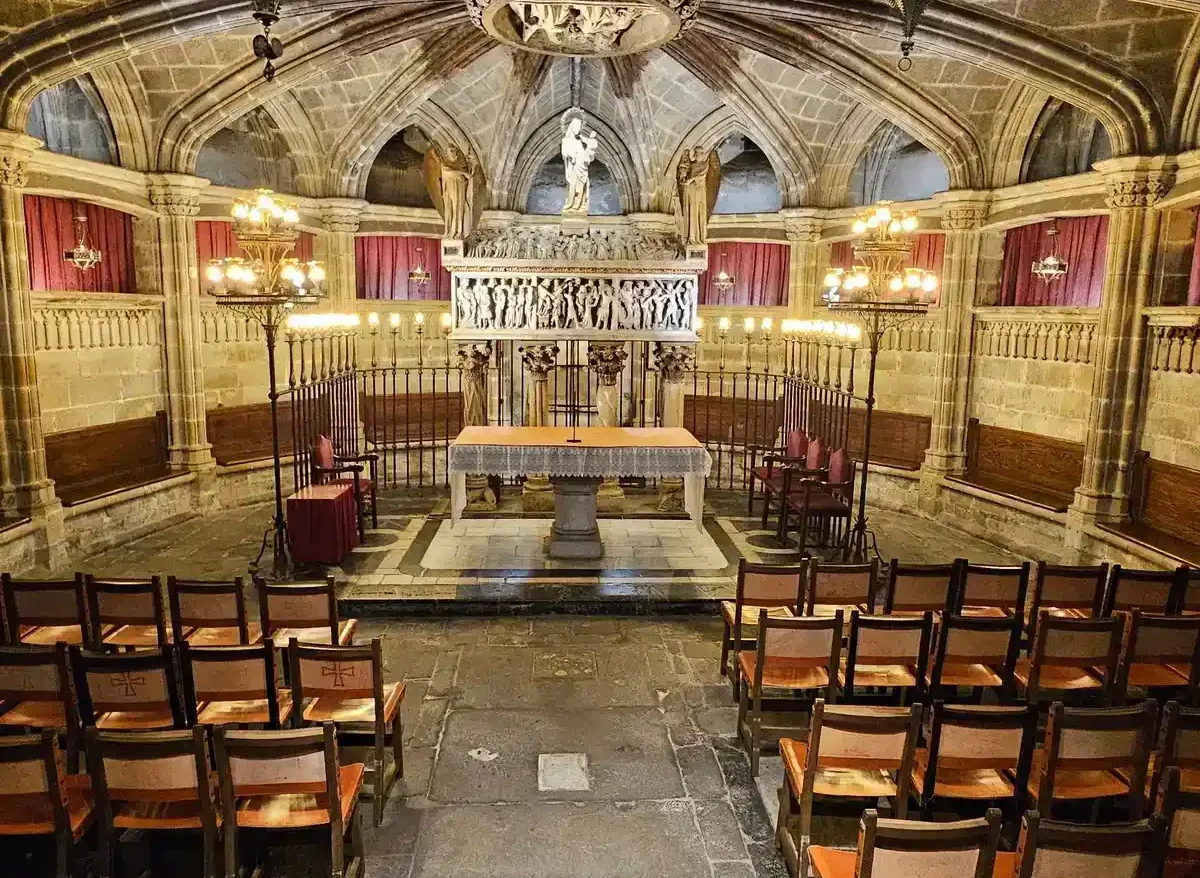
Her remains were eventually brought to the cathedral and now rest in an alabaster sarcophagus within the crypt, one of the most solemn and moving spaces in the entire building. Saint Eulalia’s story is woven throughout the cathedral, from religious artwork to one of its most charming traditions: the presence of thirteen white geese living in the cloister, a symbolic number representing her age at the time of her death.
A Stunning Masterpiece of Catalan Gothic Architecture
The Exterior and Main Façade
The exterior of the Gothic Quarter Barcelona cathedral is a striking example of Catalan Gothic design, characterized by tall spires, intricate stonework, and elaborate sculptural details. The main façade, facing Plaça de la Seu, is particularly impressive, featuring rows of statues, decorative pinnacles, and a central rose window that draws the eye upward. Twin bell towers rise on either side, giving the building a sense of verticality and grandeur that dominates the surrounding square.
Despite being completed centuries after the rest of the structure, the façade’s neo-Gothic design harmonizes beautifully with the older stonework, creating a unified and powerful visual statement, and reinforcing the cathedral’s role as the anchor of the wider Gothic Quarter.
The Interior: A Space of Height and Harmony
Stepping inside the cathedral reveals a completely different atmosphere from the busy streets outside. The interior is organized around a central nave flanked by two side aisles, with slender columns rising toward ribbed vaults high above. This design, typical of Catalan Gothic architecture, creates a strong sense of height and light, even though the interior is notably darker and more intimate than many other European Gothic cathedrals.
Twenty-nine chapels line the sides of the cathedral, each dedicated to different saints and filled with religious art, sculptures, and altarpieces created over hundreds of years. These chapels tell countless small stories within the larger story of the cathedral, reflecting the devotion of generations of Barcelona’s citizens, guilds, and noble families who funded their construction and decoration.
The Choir and Its Remarkable Woodwork
At the heart of the cathedral sits the choir, an area enclosed by beautifully carved wooden stalls dating back to the 15th century. These stalls are adorned with coats of arms, intricate carvings, and decorative details connected to the Knights of the Order of the Golden Fleece, who held a significant ceremony here in 1519. The craftsmanship on display in the choir remains one of the most admired artistic features of the entire cathedral.
The Crypt of Saint Eulalia
Beneath the main altar lies the crypt, home to the alabaster sarcophagus containing the relics of Saint Eulalia. This quiet, dimly lit space carries a powerful spiritual weight, and many visitors describe it as one of the most memorable parts of their visit. The sarcophagus itself, carved in the 14th century, is considered a masterpiece of Gothic funerary art.
The Peaceful Cloister and Its Famous Geese
Perhaps the most beloved architectural feature of the Gothic Quarter Barcelona cathedral is its cloister, a serene courtyard enclosed by graceful Gothic arcades. Unlike the more solemn atmosphere of the main nave, the cloister feels alive and intimate, filled with palm trees, magnolias, a central fountain, and, most famously, thirteen white geese.
These geese have lived in the cloister for centuries, and their presence is deeply tied to the legend of Saint Eulalia. Beyond their symbolic meaning, they have become one of the cathedral’s most charming and photographed details, delighting visitors of all ages. The cloister also contains several small chapels, along with the Chapel of Santa Llúcia, a Romanesque structure that predates the Gothic cathedral itself and was later incorporated into the larger complex.
Rooftop Views Over the City
For those able to access them, the cathedral’s rooftop terraces offer a rewarding and rare perspective. From above, visitors can admire the intricate stonework of the towers, the layout of the surrounding Gothic Quarter, and sweeping views across Barcelona’s historic center. Seeing the cathedral from this vantage point highlights the sheer scale and craftsmanship of the building in a way that is impossible to appreciate from the ground alone.
The Enchanting Neighborhood Around the Cathedral
A Neighborhood Shaped by Centuries of History
The Gothic Quarter Barcelona cathedral does not stand alone. It is the heart of the Barri Gòtic, or Gothic Quarter, one of the most atmospheric and historically rich neighborhoods in all of Europe. Wandering through this district feels like stepping backward through time, as narrow medieval lanes wind between buildings that have stood for hundreds of years.
The Gothic Quarter’s layout still largely follows the street pattern established during the medieval period, with occasional traces of the even older Roman city of Barcino still visible today. Fragments of Roman walls, gates, and towers can be found scattered throughout the neighborhood, quietly coexisting with Gothic churches, Renaissance palaces, and lively modern shops and cafés.
Plaça del Rei and Plaça Sant Jaume
Just steps from the cathedral lies Plaça del Rei, a beautifully preserved medieval square once connected to the royal palace of the Counts of Barcelona. This tranquil plaza retains much of its original medieval character and offers a glimpse into the city’s political and royal history.
Nearby, Plaça Sant Jaume serves as the civic heart of Barcelona, home to both the Catalan regional government building and Barcelona’s city hall. This square has been a center of political life since Roman times, when it stood at the intersection of the city’s two main roads, just a short walk from the Gothic Quarter Barcelona cathedral.
Roman Remains Hidden in Plain Sight
One of the most fascinating aspects of the Gothic Quarter is how seamlessly ancient Roman remains blend into everyday city life. Sections of the old Roman wall can be seen incorporated directly into later medieval buildings, while underground archaeological sites reveal remnants of Roman streets, workshops, and public spaces. This layering of Roman, medieval, and modern Barcelona is part of what makes the neighborhood surrounding the cathedral so uniquely powerful to explore.
Charming Streets and Hidden Squares
Beyond its major landmarks, the true charm of the Gothic Quarter lies in its smaller details: narrow cobblestone streets, hidden courtyards, and unexpected small squares tucked between towering stone buildings. Streets like Carrer del Bisbe, with its striking Gothic bridge connecting two historic buildings, or the quiet corners near Santa Maria del Pi, offer countless opportunities for discovery just minutes from the cathedral’s front steps.
Local shops, traditional bakeries, art galleries, and cozy cafés line many of these streets, creating a lively contrast to the historic architecture surrounding them. This blend of past and present gives the area around the Gothic Quarter Barcelona cathedral its distinctive, unforgettable atmosphere.
A Perfect Starting Point for Exploring Barcelona
Because of its central location, the Gothic Quarter Barcelona cathedral makes an ideal starting point for exploring the wider old town and beyond. From the cathedral, visitors can easily continue toward La Rambla, the bustling boulevard connecting the old city to the waterfront, or head toward the nearby El Born district, known for its artistic energy and historic market halls.
This connectivity means a visit to the cathedral naturally flows into a broader exploration of Barcelona’s historic center, making it one of the most efficient and rewarding stops on any itinerary.
Why the Gothic Quarter Barcelona Cathedral Remains a Must-See Landmark
The Gothic Quarter Barcelona cathedral offers something increasingly rare in a major tourist destination: an authentic, layered connection to the past. Its stones hold the memory of Roman worshippers, medieval builders, royal ceremonies, and centuries of everyday devotion. Its architecture showcases the height of Catalan Gothic craftsmanship, while its cloister and famous geese add a touch of warmth and wonder rarely found in monuments of this scale.
Surrounded by the timeless streets of the Gothic Quarter, the cathedral is far more than a single building to admire from a distance. It is a living gateway into Barcelona’s history, inviting every visitor to slow down, look closely, and discover the powerful stories written into every column, chapel, and stone.
Whether you are drawn by architecture, history, spirituality, or simply the desire to experience one of Europe’s most captivating old cities, the Gothic Quarter Barcelona cathedral delivers a truly breathtaking experience, one that lingers in memory long after you leave the neighborhood behind.
Planning Your Visit
If you’re planning a trip to Barcelona, allow at least an hour to properly explore the cathedral and its cloister, and consider extending your visit with a walk through the surrounding Gothic Quarter. Morning visits tend to be quieter, while afternoon light brings the stained-glass windows to life in a particularly beautiful way.
Dress respectfully, as the cathedral remains an active place of worship, and be sure to look up as often as you look around; much of the building’s finest craftsmanship is found in the details overhead, from ribbed vaults to carved stone tracery.
However you choose to experience it, the Gothic Quarter Barcelona cathedral promises a memorable and rewarding visit at the heart of one of Europe’s most beloved historic cities.