

Why Place de la Concorde Is One of Paris’ Most Unforgettable Squares
Place de la Concorde is one of the most impressive, symbolic, and historically powerful places in Paris. Located between the Champs-Élysées and the Tuileries Garden, this vast square connects some of the most famous landmarks of the French capital. From here, visitors can admire the Arc de Triomphe in one direction, the Louvre Museum and Tuileries Garden in another, the Seine River nearby, and the elegant architecture of central Paris all around.
At first sight, Place de la Concorde may seem like a wide open square with traffic, fountains, and a tall Egyptian obelisk in the middle. However, when you take a little more time to understand its story, you quickly discover that this is not just another Parisian landmark. Place de la Concorde is a place where royal power, revolution, tragedy, art, urban design, and modern Paris meet in one unforgettable setting.
For many visitors, Place de la Concorde is also one of the best starting points for exploring Paris. It is located close to several must-see attractions, including the Champs-Élysées, Arc de Triomphe, Musée de l’Orangerie, Louvre Museum, Musée d’Orsay, Madeleine Church, and the Seine. This makes Place de la Concorde a perfect stop during a walking tour, a private guided tour, a sightseeing itinerary, or a romantic Paris experience.
The beauty of Place de la Concorde is not only in its monuments but also in its atmosphere. It is open, grand, dramatic, and elegant. The square offers one of the most spectacular perspectives in Paris, especially when the light changes during the day. In the morning, the soft sunlight touches the fountains and the obelisk. In the afternoon, the square becomes lively and energetic. At sunset, the view toward the Champs-Élysées and the Arc de Triomphe can be truly magical.
If you are planning a visit to Paris, Place de la Concorde deserves more than a quick photo stop. It is a place to understand, to feel, and to admire. This guide will help you discover the history, architecture, meaning, and best things to see around Place de la Concorde.
Where Is Place de la Concorde?
Place de la Concorde is located in the heart of Paris, in the 8th arrondissement. It sits at the eastern end of the Champs-Élysées, one of the most famous avenues in the world. On one side, the square opens toward the Tuileries Garden and the Louvre Museum. On the other side, it leads toward the Champs-Élysées and the Arc de Triomphe.
This location is one of the reasons why Place de la Concorde is so important. It is not hidden away in a quiet district. Instead, it stands at the center of Parisian movement, connecting royal gardens, luxury avenues, historic monuments, museums, and the river.
From Place de la Concorde, you can easily walk to several major attractions. The Tuileries Garden is just beside the square. The Musée de l’Orangerie, famous for Monet’s Water Lilies, is located nearby. The Louvre Museum is reachable by walking through the garden. The Seine River is also close, making it easy to combine a visit to Place de la Concorde with a Paris sightseeing cruise.
This central position makes Place de la Concorde ideal for visitors who want to experience the elegant and monumental side of Paris. It is also a fantastic place for photography because the square offers long, open views that are rare in the dense city center.
A Royal Beginning: The Creation of Place de la Concorde
The history of Place de la Concorde begins in the 18th century. Originally, the square was created to honor King Louis XV. At that time, it was known as Place Louis XV. The idea was to build a grand royal square that would reflect the power, prestige, and elegance of the French monarchy.
The design was part of a larger vision of Paris as a capital of beauty, order, and royal authority. The square was created with symmetry and grandeur in mind. Its wide open space was unusual and impressive, especially compared with the narrow medieval streets that still existed in many parts of Paris.
The square became a stage for royal image and public life. It was designed not only as a practical urban space but also as a symbol. In the 18th century, squares, statues, and avenues were powerful tools of communication. They showed who ruled, what values mattered, and how the city wished to present itself.
However, the destiny of Place de la Concorde changed dramatically during the French Revolution. A place originally connected with royal glory became one of the most famous and tragic sites of revolutionary history.
Place de la Concorde During the French Revolution
No story about Place de la Concorde can ignore the French Revolution. During this period, the square became one of the most dramatic places in Paris. It was renamed Place de la Révolution and became the site of the guillotine.
Many people were executed here during the Revolution, including King Louis XVI and Queen Marie Antoinette. This fact gives Place de la Concorde a deep historical weight. Visitors today see fountains, traffic, elegant buildings, and the Luxor Obelisk, but beneath this beauty lies one of the most intense chapters in French history.
The French Revolution changed not only France but also Europe and the world. Ideas of monarchy, citizenship, equality, power, and justice were transformed. Place de la Concorde stood at the center of these changes. It was a public space where history became visible in its most powerful and tragic form.
The name “Concorde” means harmony or agreement. This later name was chosen as a symbol of reconciliation after the violence and division of the revolutionary years. In this way, Place de la Concorde represents both conflict and peace. It reminds visitors of the dangers of political violence, but also of the possibility of rebuilding a society after difficult times.
Today, this contrast makes the square especially moving. Place de la Concorde is beautiful, but it is not empty beauty. It carries memory. It invites visitors to reflect on the past while standing in one of the most elegant spaces in Paris.
The Luxor Obelisk: The Ancient Heart of Place de la Concorde
The most recognizable monument at Place de la Concorde is the Luxor Obelisk. Standing proudly in the center of the square, this ancient Egyptian monument gives the area its unique character. It is one of the most photographed landmarks in Paris and one of the city’s most fascinating historical treasures.
The obelisk originally came from Luxor in Egypt. Its presence in Paris creates a remarkable connection between ancient Egypt and modern France. Covered with hieroglyphs, the monument is far older than the square itself. This contrast is part of what makes Place de la Concorde so extraordinary. In one place, visitors can see traces of ancient civilization, royal Paris, revolutionary history, and modern urban life.
The Luxor Obelisk is not only beautiful because of its shape. It is beautiful because of what it represents. It speaks of travel, diplomacy, history, engineering, and admiration for ancient cultures. Moving such a massive monument from Egypt to Paris was an enormous technical achievement. Today, it stands as a dramatic vertical point in the middle of the wide square.
The golden pyramid-shaped cap at the top catches the light beautifully. On sunny days, the obelisk seems to glow against the Paris sky. At sunset, it becomes even more photogenic, especially when framed with the fountains or the distant view of the Arc de Triomphe.
For visitors, the Luxor Obelisk is the perfect starting point for understanding Place de la Concorde. It marks the center of the square and gives you a clear point from which to admire the surrounding views.
The Magnificent Fountains of Place de la Concorde
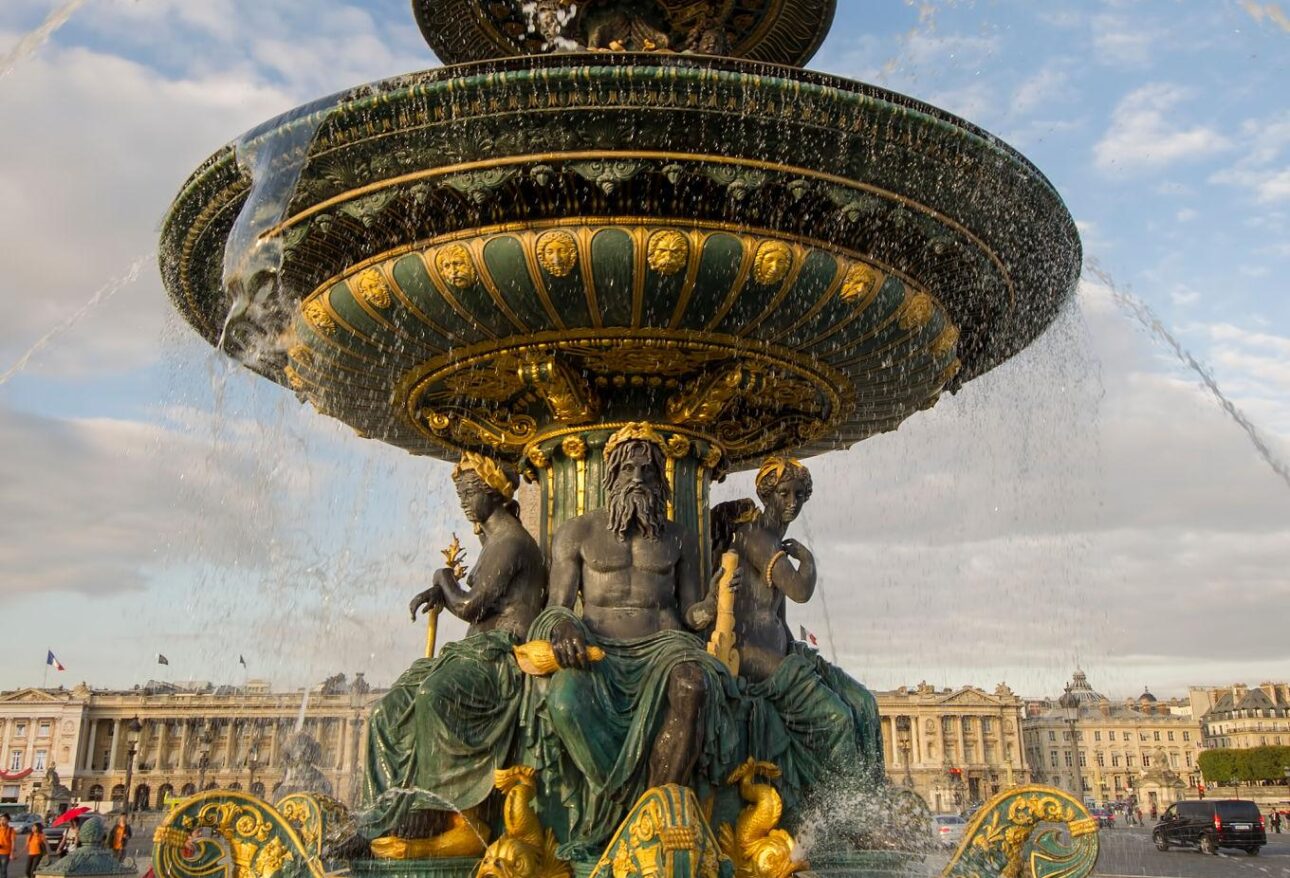
The fountains of Place de la Concorde are among the most elegant features of the square. They add movement, sound, and artistic beauty to the open space. Their sculptural details, water effects, and decorative style make them a highlight for visitors and photographers.
The two fountains are often admired for their harmony with the Luxor Obelisk and the surrounding architecture. They help soften the grandeur of the square with flowing water and rich artistic detail. The combination of stone, bronze, gold-colored decoration, and water creates a luxurious Parisian atmosphere.
The fountains are inspired by maritime and river themes. This is connected to the importance of water, navigation, commerce, and France’s relationship with seas and rivers. Their figures and ornaments create a sense of abundance, movement, and classical beauty.
Many visitors rush through Place de la Concorde without stopping to study the fountains closely. This is a mistake. The fountains are full of details that reward slow observation. Look at the figures, the fish, the shells, the flowing shapes, and the way the water changes the feeling of the square. In a place with such heavy history, the fountains bring life and elegance.
They are especially beautiful in photographs. Try capturing them with the Luxor Obelisk in the background, or with the sky reflected in the water. In the right light, the fountains of Place de la Concorde can look truly spectacular.
The Best Views From Place de la Concorde
One of the most exciting reasons to visit Place de la Concorde is the view. Because the square is so open, it offers some of the best perspectives in central Paris. This is a place where the city seems to unfold in several directions at once.
Looking west, you can see the Champs-Élysées leading toward the Arc de Triomphe. This long perspective is one of the most famous urban views in the world. The avenue, trees, traffic, lights, and distant arch create a powerful image of Parisian grandeur.
Looking east, you can see the Tuileries Garden and continue visually toward the Louvre Museum. This direction is softer and more elegant, with greenery, paths, statues, and museum architecture. It is perfect for visitors who want to walk from royal gardens to world-class art.
Looking south, the Seine River is nearby, with bridges leading toward the Left Bank. From there, you can continue toward the Musée d’Orsay, one of Paris’ most beloved museums. Looking north, you can admire the elegant buildings that frame the square and continue toward the Madeleine Church.
This unique combination of views makes Place de la Concorde feel like a crossroads of Paris. It is not only a destination but also a connector. It links monuments, neighborhoods, stories, and experiences.
For first-time visitors, this is a wonderful place to understand the geography of central Paris. For returning visitors, it is a place to enjoy the city’s rhythm and beauty again and again.
Why Place de la Concorde Is Important in Paris
Place de la Concorde is important because it combines several layers of Parisian identity. It is royal, revolutionary, artistic, symbolic, and urban at the same time.
First, it is important as a royal square. Its original purpose was to celebrate monarchy and create a monumental public space. This connects it to the grand tradition of European urban design.
Second, it is important because of the French Revolution. Few places in Paris carry such strong historical memory. The execution of Louis XVI and Marie Antoinette made the square a place of world-historical significance.
Third, it is important because of its design. The size, symmetry, monuments, fountains, and views make Place de la Concorde one of the most impressive urban spaces in Europe.
Fourth, it is important because of its location. It connects the Champs-Élysées, Tuileries Garden, Louvre Museum, Seine River, and other major attractions. It is both a landmark and a gateway.
Finally, it is important because it represents transformation. Over time, the square changed names, meanings, and symbols. From royal power to revolution, from violence to harmony, from political drama to tourist beauty, Place de la Concorde tells the story of Paris itself.
What to See at Place de la Concorde
Place de la Concorde can be visited at any time of day, but some moments are especially beautiful.
Morning is a great time if you want fewer people and softer light. The square feels calmer, and the fountains and obelisk are easier to photograph. It is also a good time to start a walking itinerary toward the Tuileries Garden and the Louvre Museum.
Afternoon is lively and energetic. The square becomes busier, and you can feel the movement of Paris around you. This is a good time if you want to combine Place de la Concorde with shopping on the Champs-Élysées or a museum visit nearby.
Sunset is perhaps the most magical time. The light can be beautiful, especially toward the Arc de Triomphe and the Champs-Élysées. The obelisk and fountains become more dramatic, and the square takes on a romantic atmosphere.
Evening can also be impressive, especially when the city lights begin to shine. Place de la Concorde feels grand and cinematic at night, although visitors should always stay aware of traffic and use pedestrian crossings carefully.
How Long Should You Spend at Place de la Concorde?
If you are simply passing through, you can see Place de la Concorde in 15 to 20 minutes. This gives you enough time to take photos of the obelisk, fountains, and views.
However, if you want to understand the square properly, plan at least 30 to 45 minutes. This allows you to walk around, observe the monuments, read about the history, and enjoy the atmosphere.
If you combine Place de la Concorde with nearby attractions, you can easily spend half a day in the area. For example, you could start at the Arc de Triomphe, walk down the Champs-Élysées, visit Place de la Concorde, continue through the Tuileries Garden, and finish at the Louvre Museum. Another beautiful option is to visit the Musée de l’Orangerie, then explore Place de la Concorde and walk along the Seine.
For visitors who enjoy history, photography, or architecture, Place de la Concorde is worth more than a quick stop. It is a place where the more you know, the more you see.
A Perfect Walking Route Around Place de la Concorde
A visit to Place de la Concorde fits perfectly into a classic Paris walking route. Here is a simple and enjoyable itinerary.
Start at the Arc de Triomphe, one of the most famous monuments in Paris. From there, walk down the Champs-Élysées. This avenue offers shops, cafés, theaters, and a lively Parisian atmosphere.
Continue until you reach Place de la Concorde. Stop in the square to admire the Luxor Obelisk, fountains, and views. Take your time to understand the history and enjoy the open space.
Next, enter the Tuileries Garden. This elegant garden is perfect for a relaxing walk. You can sit near one of the ponds, enjoy the statues, and take beautiful photos.
If you love art, visit the Musée de l’Orangerie, located near the garden. It is especially famous for Monet’s Water Lilies. Alternatively, continue through the Tuileries toward the Louvre Museum.
After the Louvre, you can walk toward the Seine or enjoy a sightseeing cruise. This route gives you a wonderful combination of Paris history, architecture, gardens, museums, and river views.
Place de la Concorde is the central point of this itinerary. It connects everything and gives the route its grand Parisian character.
Place de la Concorde and the Champs-Élysées
Place de la Concorde and the Champs-Élysées are closely connected. The square marks the eastern end of the avenue, while the Arc de Triomphe stands at the western end. Together, they create one of the most famous urban axes in the world.
The Champs-Élysées is known for shopping, restaurants, cinemas, events, and luxury. Place de la Concorde gives the avenue a historic and monumental beginning. When you stand in the square and look toward the Arc de Triomphe, you can feel the power of Parisian urban planning.
This connection makes Place de la Concorde an essential stop for anyone visiting the Champs-Élysées. Without seeing the square, the avenue feels incomplete. The two landmarks belong together.
For visitors, this also creates a practical advantage. You can easily combine a walk along the Champs-Élysées with a visit to Place de la Concorde and the Tuileries Garden. It is one of the most enjoyable and classic Paris experiences.
Place de la Concorde and the Tuileries Garden
On the eastern side of Place de la Concorde, the Tuileries Garden offers a completely different atmosphere. After the wide, dramatic square, the garden feels peaceful and refined. This contrast is part of the pleasure of visiting the area.
The Tuileries Garden was historically connected to royal Paris. Today, it is one of the most beloved public gardens in the city. Visitors can walk along tree-lined paths, admire statues, sit near fountains, and enjoy views toward the Louvre Museum.
Place de la Concorde acts as the grand entrance to the garden from the west. This makes the transition from square to garden especially beautiful. One moment you are standing among traffic, monuments, and history; the next, you are walking through greenery and calm.
This combination is ideal for families, couples, solo travelers, and photographers. It also makes the area a wonderful choice if you want to experience Paris without rushing from one ticketed attraction to another.
Place de la Concorde for Photography Lovers
Place de la Concorde is a fantastic location for photography. Its open space, monuments, fountains, and long perspectives offer many creative possibilities.
The Luxor Obelisk is the obvious subject. You can photograph it alone against the sky, frame it with the fountains, or include the surrounding buildings for a more complete composition.
The fountains are also excellent subjects. Their sculptural details and water movement create dynamic images. Try photographing them from different angles, especially with the obelisk or sky in the background.
The view toward the Arc de Triomphe is another classic shot. Because the Champs-Élysées stretches in a straight line from the square, you can capture a dramatic Parisian perspective.
Sunset photography is especially rewarding at Place de la Concorde. The light changes quickly, and the square can look golden, romantic, and cinematic. Evening photos can also be beautiful when the monuments and streetlights create contrast.
For the best photos, be patient. The square is busy, and traffic can make composition challenging. However, with the right angle and timing, Place de la Concorde can give you some of the most memorable images of your Paris trip.
Is Place de la Concorde Free to Visit?
Yes, Place de la Concorde is a public square and can be visited for free. You do not need a ticket to walk around the square, see the obelisk, admire the fountains, or enjoy the views.
This makes Place de la Concorde an excellent attraction for travelers who want to experience Paris on any budget. It is also a great stop between paid attractions such as museums, guided tours, or river cruises.
Although the square itself is free, many nearby attractions require tickets. The Musée de l’Orangerie, Louvre Museum, Musée d’Orsay, Arc de Triomphe rooftop, and certain guided tours should be booked in advance, especially during busy seasons.
A smart Paris itinerary can combine free landmarks like Place de la Concorde with ticketed attractions nearby. This gives visitors a richer and more balanced experience.
Travel Tips for Visiting Place de la Concorde
When visiting Place de la Concorde, it is important to remember that it is a very large and busy square. Traffic can be intense, so always use official pedestrian crossings and pay attention when moving around.
Wear comfortable shoes, especially if you plan to continue toward the Champs-Élysées, Tuileries Garden, Louvre Museum, or Seine River. The area is best explored on foot, and walking allows you to appreciate the views properly.
Bring a camera or make sure your phone is charged. Place de la Concorde is one of the best photo spots in central Paris.
Try to visit in good weather if possible. Since the square is open and exposed, rain or strong wind can make the experience less comfortable. On sunny days, however, the open sky makes the square feel magnificent.
If you are interested in history, consider joining a guided tour. A guide can explain the royal origins, revolutionary events, symbolism, and architectural details that many visitors miss.
Finally, do not rush. Place de la Concorde is more meaningful when you slow down and look carefully. The square is not only something to see; it is something to understand.
Nearby Attractions Around Place de la Concorde
One of the best things about Place de la Concorde is its location near many of Paris’ top attractions.
The Champs-Élysées is directly connected to the square. This famous avenue is perfect for a walk, shopping, or continuing toward the Arc de Triomphe.
The Tuileries Garden is beside the square and offers a peaceful green escape. It is ideal for a relaxing break or a beautiful walk toward the Louvre Museum.
The Musée de l’Orangerie is nearby and is a must-see for art lovers, especially those interested in Impressionism and Monet.
The Louvre Museum is within walking distance through the Tuileries Garden. It is one of the greatest museums in the world and home to masterpieces such as the Mona Lisa.
The Seine River is also close. From there, visitors can enjoy riverside walks, bridges, and sightseeing cruises.
The Musée d’Orsay is across the river and offers another extraordinary art experience, especially for fans of Impressionist and Post-Impressionist painting.
The Madeleine Church is north of the square and adds another architectural highlight to the area.
Because of these nearby attractions, Place de la Concorde is not an isolated stop. It is part of a larger Paris experience.
Why Place de la Concorde Is Perfect for First-Time Visitors
For first-time visitors to Paris, Place de la Concorde is a perfect introduction to the city. It offers history, beauty, monuments, views, and easy access to famous landmarks.
Many first-time visitors want to understand how Paris is organized. Place de la Concorde helps with this because it connects so many important places. From the square, you can see or reach several major attractions without needing complicated transportation.
It is also a place that shows different sides of Paris. The obelisk represents ancient history and international connection. The fountains represent artistic elegance. The square’s revolutionary past represents political drama. The surrounding views represent urban beauty and planning.
This mix makes Place de la Concorde especially valuable for travelers who want more than simple sightseeing. It gives visitors a deeper feeling for the city.
Why Place de la Concorde Is Also Special for Returning Visitors
Even if you have visited Paris before, Place de la Concorde remains worth revisiting. The square changes with the weather, the light, the season, and the time of day.
In spring, nearby gardens bring freshness and color. In summer, the square feels bright and energetic. In autumn, the walk through the Tuileries becomes especially charming. In winter, the open space can feel dramatic and elegant.
Returning visitors may also appreciate the square more after learning about French history. Once you understand the layers of meaning, Place de la Concorde becomes much more than a famous traffic circle or photo spot.
It is one of those Paris landmarks that grows richer with time. Every visit can reveal something new.
Suggested Itinerary: Half-Day Around Place de la Concorde
If you want to build a half-day itinerary around Place de la Concorde, here is a beautiful plan.
Begin your morning at the Arc de Triomphe. Enjoy the monument and, if possible, visit the rooftop for panoramic views.
Then walk down the Champs-Élysées toward Place de la Concorde. Take your time and enjoy the atmosphere of the avenue.
Arrive at Place de la Concorde and spend around 30 minutes exploring the square. Photograph the Luxor Obelisk, admire the fountains, and look in every direction to understand the layout.
Next, walk into the Tuileries Garden. Enjoy a peaceful break, sit by a pond, and continue toward the Musée de l’Orangerie or the Louvre Museum.
If you choose the Musée de l’Orangerie, you can enjoy a shorter but deeply beautiful museum visit. If you choose the Louvre, plan more time because the museum is enormous.
Finish your experience with a walk along the Seine or a sightseeing cruise. This creates a perfect Paris combination of monument, avenue, garden, museum, and river.
Place de la Concorde: A Symbol of Parisian Elegance and Memory
Place de la Concorde is one of the most powerful places in Paris because it combines elegance with memory. It is beautiful, but it is also serious. It is grand, but it is also emotional. It is a place of movement, but also a place of reflection.
The square has witnessed monarchy, revolution, transformation, and modern tourism. It has changed names and meanings, yet it remains one of the central spaces of Paris. Its monuments tell stories from different centuries and different civilizations. Its views connect some of the most famous landmarks in the city.
For visitors, Place de la Concorde offers a chance to experience Paris in a deeper way. You can admire the fountains, photograph the obelisk, walk toward the Champs-Élysées, relax in the Tuileries Garden, or continue toward the museums and the river. But beyond all of this, you can feel the weight of history in a beautiful public space.
That is what makes Place de la Concorde unforgettable. It is not simply a square. It is a stage where Paris reveals its power, beauty, tragedy, harmony, and timeless charm.
Conclusion: Should You Visit Place de la Concorde?
Yes, Place de la Concorde is absolutely worth visiting. It is one of the most important public squares in Paris and one of the best places to understand the city’s history, layout, and elegance.
Whether you are interested in the French Revolution, royal Paris, ancient monuments, photography, walking routes, or simply beautiful views, Place de la Concorde offers something special. It is easy to visit, free to explore, and perfectly located near many top Paris attractions.
For the best experience, do not treat Place de la Concorde as just a quick stop between the Champs-Élysées and the Louvre. Take time to stand in the square, look around, and imagine the many layers of history that have passed through this space.
From the Luxor Obelisk to the fountains, from the Tuileries Garden to the view of the Arc de Triomphe, Place de la Concorde is one of those rare places where the whole story of Paris seems to come together.
If you are planning your Paris itinerary, make sure Place de la Concorde is on your list. It is powerful, beautiful, historic, and unforgettable – a true symbol of the French capital.