

A Sagrada Familia visit is one of the most unforgettable experiences in Barcelona. This world-famous basilica is not only the most iconic landmark in the city, but also one of the most extraordinary architectural projects in the world. With its soaring towers, symbolic façades, colorful stained-glass windows, and breathtaking interior, the Sagrada Familia attracts millions of visitors every year.
Designed by Antoni Gaudí, the Sagrada Familia is much more than a church. It is a spiritual monument, an architectural dream, and a symbol of Barcelona’s creative identity. Construction began in 1882, and Gaudí took over the project in 1883, transforming it into a unique masterpiece that combined faith, nature, geometry, and Catalan modernism. More than 140 years later, construction continues, making the basilica one of the most fascinating unfinished monuments in the world.
For many travelers, a Sagrada Familia visit is the highlight of their trip to Barcelona. However, because it is so popular, planning ahead is very important. During high season, tickets can sell out several weeks in advance, especially for the most popular time slots and tower access. For this reason, visitors should book early or consider other beautiful cultural experiences in Barcelona, such as the Cathedral of Barcelona.
The History of the Sagrada Familia
The full name of the monument is the Basilica of the Sagrada Familia, which means the Basilica of the Holy Family. Its construction began in the late 19th century, during a period when Barcelona was growing rapidly and becoming one of the most important cultural centers in Europe.
The original project was started by architect Francisco de Paula del Villar. However, shortly after construction began, Antoni Gaudí became the lead architect. From that moment, the project changed completely. Gaudí did not want to create a traditional church. Instead, he imagined a monumental basilica filled with symbolism, natural forms, religious meaning, and innovative architectural solutions.
Gaudí dedicated the final years of his life almost entirely to the Sagrada Familia. He worked on the project with deep spiritual devotion and saw the basilica as a work dedicated to God. When he died in 1926, only part of the church had been completed. Nevertheless, his models, drawings, and ideas continued to guide later generations of architects and craftsmen.
Today, a Sagrada Familia visit allows travelers to see a monument that connects the past, present, and future. It is both historic and still alive, because construction and restoration work continue to shape the building.
Gaudí’s Vision and Symbolism
One of the reasons why a Sagrada Familia visit is so special is the amount of symbolism hidden in the design. Gaudí believed that architecture should tell a story. Every façade, tower, sculpture, column, and decorative detail has meaning.
The basilica was designed to tell the story of the life of Jesus Christ. The three main façades represent important moments in Christian belief. The Nativity Façade celebrates the birth of Jesus and is full of life, nature, animals, plants, and joyful decoration. The Passion Façade represents the suffering and death of Christ. It is more dramatic, sharp, and emotional. The Glory Façade, still under development, is intended to represent the path to God and eternal life.
The towers are also deeply symbolic. When completed, the basilica is planned to have 18 towers, representing Jesus Christ, the Virgin Mary, the four Evangelists, and the twelve Apostles. The tower of Jesus Christ is designed to become the tallest point of the basilica, but Gaudí intentionally planned it to remain lower than Montjuïc hill, because he believed that human creation should not exceed God’s creation.
The Interior: A Forest of Stone and Light
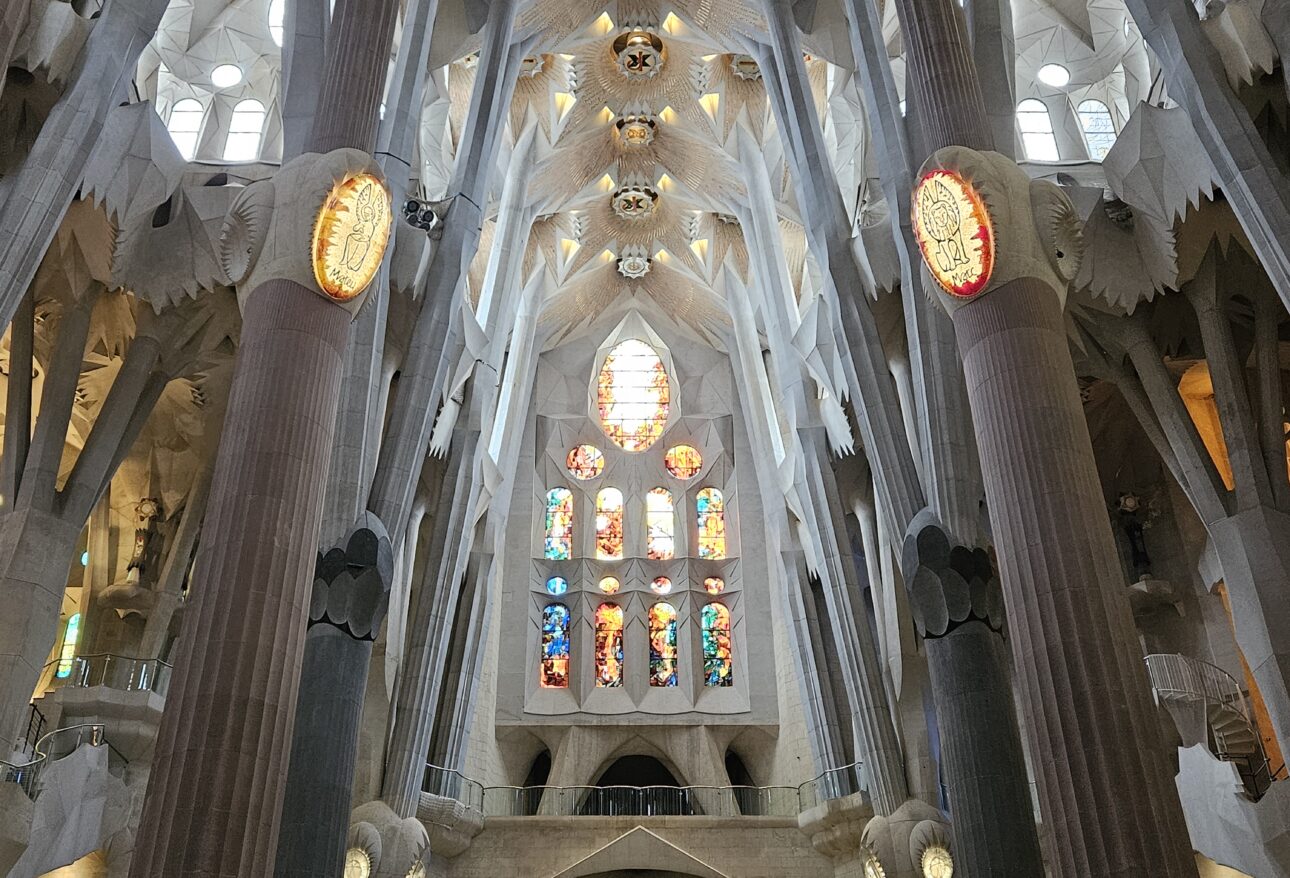
The interior is one of the most impressive parts of any Sagrada Familia visit. Many visitors are surprised by the feeling of light, height, and movement inside the basilica. Gaudí designed the columns to resemble trees, creating the feeling of walking through a sacred forest.
The columns branch out as they rise, supporting the ceiling in a way that feels organic and natural. This design was not only beautiful but also structurally innovative. Gaudí studied nature carefully and used natural forms to solve architectural problems.
The stained-glass windows are another unforgettable feature. Depending on the time of day, the interior changes completely. Morning light may create cooler blue and green tones, while afternoon sunlight can fill the space with warmer reds, oranges, and yellows. This play of color gives the basilica a peaceful and almost magical atmosphere.
For photography lovers, the interior is one of the most beautiful places in Barcelona. However, the real beauty of the space is not only in photos. It is in the feeling of standing inside one of the most creative religious buildings ever designed.
The Façades of the Sagrada Familia
A complete Sagrada Familia visit should include time to admire the façades from the outside. Each façade has its own style and emotional character.
The Nativity Façade is the most detailed and decorative. It was the part most directly influenced by Gaudí during his lifetime. It is full of natural elements, religious figures, animals, and joyful scenes. This façade celebrates birth, creation, and hope.
The Passion Façade is very different. Its sculptures are sharper and more dramatic. The figures appear stretched, angular, and intense. This façade tells the story of suffering, sacrifice, and death. Some visitors find it powerful, while others find it severe. In both cases, it creates a strong emotional impression.
The Glory Façade is planned to become the main entrance to the basilica. It represents spiritual ascent and the journey toward God. Although still unfinished, it is an important part of Gaudí’s overall vision.
The Towers and Views
Depending on the ticket type, some visitors can include tower access during their Sagrada Familia visit. The towers offer a different perspective on the basilica and the city. From above, visitors can see details of the architecture that are difficult to notice from street level.
The views over Barcelona are also impressive. However, tower access is usually limited and can sell out faster than general entry. Visitors who want to include the towers should book as early as possible, especially during spring, summer, holidays, and high travel periods.
It is also important to note that tower visits may not be suitable for everyone. There are stairs, narrow passages, and height considerations. Travelers should always check the ticket conditions before booking.
Why the Sagrada Familia Is So Popular
A Sagrada Familia visit is popular because the monument is completely unique. There is no other church in the world quite like it. It combines Gothic inspiration, Art Nouveau, Catalan modernism, Christian symbolism, advanced geometry, and Gaudí’s personal imagination.
The basilica is also connected to Barcelona’s identity. It is not only a tourist attraction but a symbol of the city itself. Its silhouette appears on postcards, travel guides, social media, documentaries, and cultural campaigns around the world.
The Sagrada Familia is also connected to UNESCO heritage through Gaudí’s works. The Nativity Façade and the crypt are part of the UNESCO World Heritage listing for the Works of Antoni Gaudí, highlighting the global importance of his architecture. The basilica was also consecrated by Pope Benedict XVI in 2010 and designated a minor basilica.
Tips for Planning Your Sagrada Familia Visit
Because the basilica is one of the most visited attractions in Spain, good planning is essential. Tickets are usually sold with timed entry, and the most convenient time slots can disappear quickly. The official Sagrada Família website also presents official ticket options and visitor information for planning your visit.
For the best experience, try to book in advance. Morning visits can be a good choice if you prefer a calmer start to the day. Afternoon visits can be especially beautiful because of the warm light entering through the stained-glass windows.
Allow enough time for your visit. Even if you only plan to see the interior, you should not rush. The basilica is full of details, and the outside façades are also worth careful attention. If you include tower access, you will need more time.
Comfortable shoes are recommended, especially if you plan to walk around the exterior or continue exploring the neighborhood afterward.
Is the Sagrada Familia Worth Visiting?
Yes, absolutely. A Sagrada Familia visit is one of the most important things to do in Barcelona. Even visitors who are not especially interested in churches often find the basilica impressive because of its originality, scale, colors, and atmosphere.
It is ideal for architecture lovers, first-time visitors, photographers, families, couples, and anyone interested in Barcelona’s cultural identity. The monument offers a powerful combination of beauty, history, faith, and creativity.
However, it is also important to be realistic. The Sagrada Familia is extremely popular, and during high season it can be difficult to find tickets at the last minute.
When Sagrada Familia Tickets Are Sold Out: Visit the Cathedral of Barcelona
During high season, the Sagrada Familia can be booked up to three weeks in advance, especially for popular time slots and tower access. This can be disappointing for visitors who arrive in Barcelona without planning early.
If Sagrada Familia tickets are sold out, or if you want to discover another important religious monument in the city, we highly recommend visiting the Cathedral of Barcelona.
The Cathedral of Barcelona is a completely different experience, but it is also one of the most beautiful landmarks in the city. Located in the Gothic Quarter, it represents the medieval heart of Barcelona. While the Sagrada Familia shows Gaudí’s modernist genius, the Cathedral of Barcelona reveals the city’s Gothic history, religious tradition, and old-town atmosphere.
A visit to the Cathedral of Barcelona allows you to explore high vaulted ceilings, chapels, stained-glass windows, a peaceful cloister, and the famous 13 white geese connected to Saint Eulalia. It is also perfectly located for exploring the Gothic Quarter, Roman walls, historic squares, local cafés, and charming medieval streets.
For many travelers, the best choice is to visit both monuments if possible. The Sagrada Familia shows the modern and visionary side of Barcelona. The Cathedral of Barcelona shows the ancient and historic soul of the city.
Final Thoughts
A Sagrada Familia visit is one of the most unforgettable experiences in Barcelona. From Gaudí’s extraordinary vision to the colorful interior, symbolic façades, soaring towers, and ongoing construction, the basilica offers something truly unique.
It is a monument of faith, creativity, patience, and imagination. More than 140 years after construction began, it continues to grow and inspire visitors from all over the world.
However, because the Sagrada Familia is so famous, tickets often sell out far in advance during high season. Therefore, visitors should book early whenever possible. If tickets are unavailable, the Cathedral of Barcelona is a wonderful alternative and a must-see monument in its own right.
Whether you choose the Sagrada Familia, the Cathedral of Barcelona, or both, Barcelona offers some of the most remarkable religious architecture in Europe. Each monument tells a different story, and together they reveal the rich history, creativity, and spirit of the city.