

Sainte-Chapelle Private Guided Tour
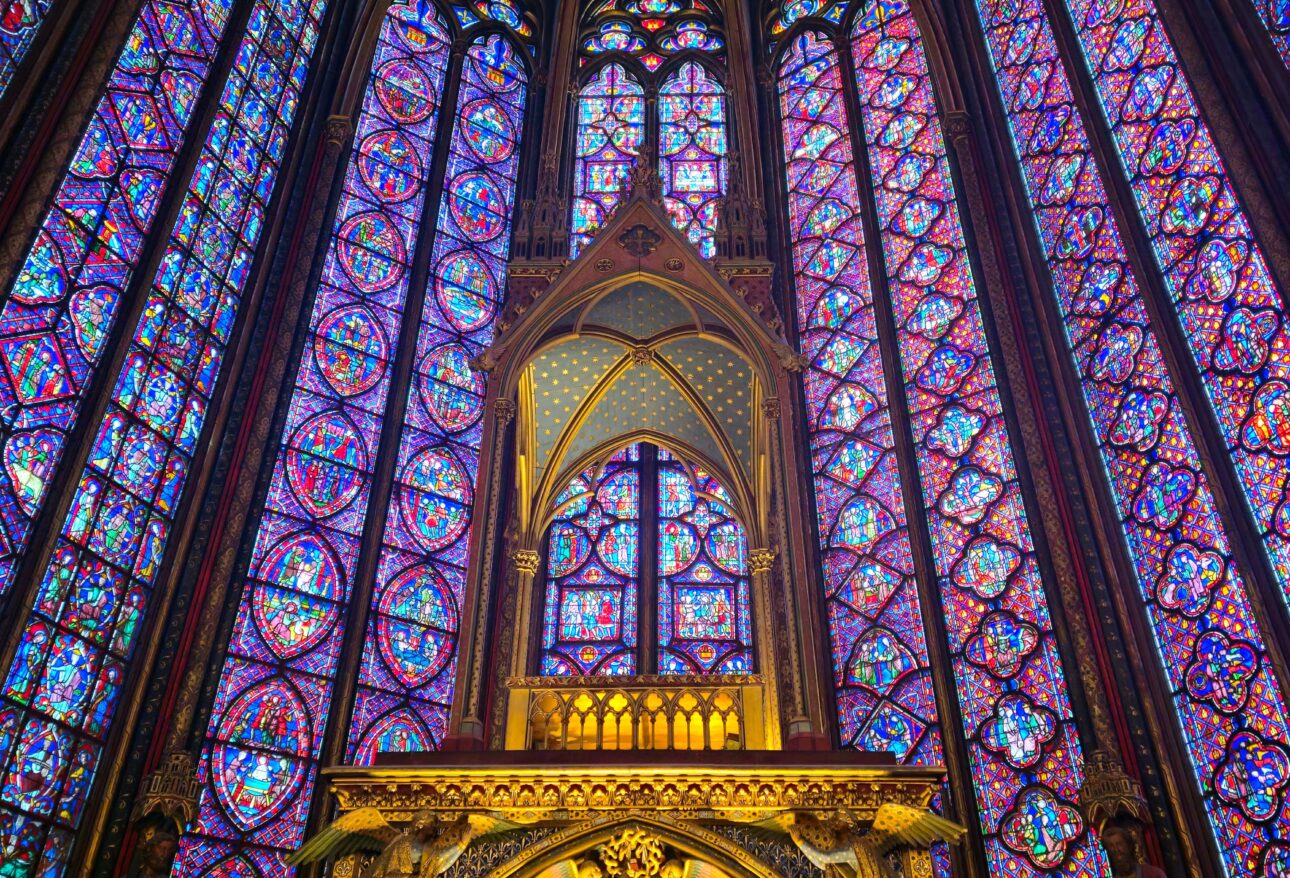
Tucked behind the towering walls of the Palais de Justice on the Île de la Cité, just a few hundred meters from Notre-Dame Cathedral, sits a building so extraordinary that first-time visitors often walk straight past its plain stone facade without realizing what waits inside. Then they climb a narrow spiral staircase, step through a low doorway, and stop dead in their tracks. Above them, fifteen towering windows of jewel-colored glass rise more than fifteen meters into the air, flooding the room with a kaleidoscope of ruby, sapphire, and gold light. This is the Sainte-Chapelle, and nothing in Paris – not even Notre-Dame itself – prepares you for the moment the light hits the glass.
For travelers who want to understand exactly what they are looking at, rather than simply photograph it, a Sainte-Chapelle private guided tour is the difference between a pretty stop on a checklist and one of the most moving experiences of a trip to France. In this guide, we’re pulling back the curtain on seven secrets about this Gothic masterpiece that most visitors never learn, along with everything you need to know to plan a visit that does the building justice.
A Quick Introduction to the Sainte-Chapelle
Before we dive into the secrets, here is the short version for anyone in a hurry. The Sainte-Chapelle (“Holy Chapel”) was built in the 13th century by King Louis IX of France – later canonized as Saint Louis – as a private royal chapel to house what was, at the time, considered the most valuable object in Christendom: the Crown of Thorns. The chapel is famous above all for its stained glass: fifteen windows containing 1,113 individual scenes drawn from the Old and New Testaments, arranged like a stone-and-glass illuminated manuscript that visitors are meant to “read” from bottom to top, left to right.
It is one of the purest surviving examples of Rayonnant Gothic architecture anywhere in the world, and UNESCO recognizes it, along with Notre-Dame and the Conciergerie, as part of the Paris, Banks of the Seine World Heritage Site. Despite sitting in the shadow of its more famous neighbor, many art historians consider the Sainte-Chapelle the single greatest surviving achievement of medieval French stained glass. Let’s get into why.
Secret 1: It Was Built to Be More Precious Than a Crown Jewel
Most people assume grand European chapels were built primarily to glorify God in the abstract. The Sainte-Chapelle was built for a far more specific and startling reason: to house a relic that Louis IX believed was more valuable than his entire kingdom.
In 1239, Louis IX acquired the Crown of Thorns – believed to be the very crown pressed onto the head of Jesus during the Crucifixion – from Baldwin II, the cash-strapped Latin Emperor of Constantinople. The price was staggering: 135,000 livres tournois, roughly half the annual revenue of the entire kingdom of France. Louis went on to acquire additional relics, including a fragment of the True Cross, until the collection totaled twenty-two sacred objects. The chapel itself, by comparison, cost around 40,000 livres to build – meaning Louis spent more than three times as much on the relics as he did on the extraordinary building constructed to hold them.
This single fact reframes the entire building. The Sainte-Chapelle wasn’t conceived first and decorated later; it was designed from the ground up as an elaborate reliquary you could walk inside – essentially a piece of goldsmith’s jewelry scaled up to the size of a cathedral nave. Every column, every rib vault, and every inch of stained glass was engineered to make the relics housed at its east end feel like they were floating in a jeweled shrine suspended in colored light. When your guide walks you through the upper chapel and explains this context, the building stops being “a pretty church” and becomes something much stranger and more ambitious: a medieval king’s attempt to build heaven on earth for a piece of woven thorn.
Secret 2: It Was Built in Record Time – And It Shows
Grand Gothic cathedrals typically took generations, sometimes centuries, to complete. Notre-Dame took nearly two centuries from first stone to final flourish. The Sainte-Chapelle, by contrast, was built in less than seven years, reportedly completed around 1248 – a construction speed almost unheard of for a building of this ambition and delicacy.
That astonishing pace is part of what makes the structure so architecturally daring. To finish quickly while achieving maximum verticality and light, the builders pushed Gothic engineering to its absolute limit. The stone structure of the upper chapel is reduced to the thinnest possible skeleton of ribs, buttresses, and iron reinforcement bars hidden within the masonry, allowing the walls to be replaced almost entirely by glass. In effect, the architects treated stone as scaffolding and glass as the real wall. Modern engineers who study the building are still impressed that a structure this delicate has survived more than 750 years, multiple fires, a revolution, and a flood in 1910 that submerged the lower chapel.
A knowledgeable guide will point out details invisible to the casual eye: the hidden iron tie-rods threaded through the masonry, the subtle lean corrections added over the centuries, and the sheer audacity of a construction crew told to build something never before attempted, and to do it fast.
Secret 3: There Are Two Chapels, and They Were Never Meant for the Same People
Most visitors only remember the dazzling upper chapel, but the Sainte-Chapelle is actually two distinct chapels stacked on top of each other, and the separation was entirely deliberate – a reflection of medieval social hierarchy carved directly into architecture.
The lower chapel, dedicated to the Virgin Mary, is dark, low-ceilinged, and supported by sturdy columns painted in rich reds, blues, and gold fleur-de-lis patterns. This was the chapel for palace staff, guards, and lower-ranking members of the royal household – the people who lived and worked in the surrounding palace but were not considered worthy of standing in the presence of Christ’s relics.
Climb the spiral staircase, and you enter an entirely different world: the upper chapel, reserved exclusively for the king, his family, and his most privileged guests. This is where the Crown of Thorns was displayed in an elevated gilded shrine at the east end, and where the full spectacle of the stained glass was intended to be experienced by royalty alone. The contrast between the two levels – one earthbound and modest, the other soaring and luminous — was a physical, unmistakable statement about proximity to divine and royal power. A private guided tour makes a point of walking both levels slowly, so you feel that contrast rather than just reading about it on a placard.
Secret 4: The Windows Tell One Continuous Story – If You Know How to Read Them
The stained glass of the Sainte-Chapelle isn’t decorative in the way we think of decoration today. It is a complete, sequential visual Bible, containing 1,113 individual scenes across fifteen windows, each roughly fifteen meters tall. Medieval visitors, most of whom couldn’t read Latin scripture, were meant to “read” the windows the way we might read a graphic novel: starting at the bottom-left of each window and moving upward, then across to the next window in sequence.
The windows on the north side depict Old Testament figures and stories – Adam and Eve, Noah’s flood, Abraham, Moses receiving the Ten Commandments, and the kings of Israel. The south side features Judith, Job, Esther, and King David. The windows surrounding the apse focus on prophetic narratives – Daniel, Ezekiel, Isaiah, and John the Baptist – building toward the Passion of Christ depicted at the physical and spiritual center of the room, directly behind where the relics themselves were displayed. It is, quite literally, biblical history arranged in a circle around the object considered its ultimate culmination.
Remarkably, roughly two-thirds of the glass you see today is original medieval glasswork from the 13th century – a survival rate almost unheard of for stained glass this old, especially given the damage sustained during the French Revolution. The glassmakers worked with a deliberately restrained palette of red, blue, two shades of green, two shades of purple, a warm yellow, and small sections of clear or lightly tinted glass, which is part of why the light inside feels so jewel-like rather than garishly colorful. Without a guide trained to point out where the narrative starts and how the sequence unfolds panel by panel, most visitors simply see “beautiful colored glass” rather than the intricate visual sermon it actually is – which is one of the single biggest reasons travelers say a guided visit transforms their experience of the building.
Secret 5: The Rose Window Is a Deliberate Grand Finale
If the fifteen lancet windows are the long-form narrative, the rose window at the western end of the upper chapel is the dramatic conclusion. Added later than the original 13th-century windows – during a renovation commissioned by King Charles VIII around 1485 in the ornate Flamboyant Gothic style – the rose window depicts the Apocalypse of Saint John: scenes of final judgment, angels, and the end of days, radiating outward from the center in a burst of tracery and glass.
Positioned directly opposite the altar and the relic shrine, the rose window catches the last light of the setting sun, meaning the room’s visual “ending” is timed, almost theatrically, to the natural rhythm of the day. Visitors who arrive for a late-afternoon guided tour on a clear day often say this is the single most striking moment of their visit – sunlight pouring directly through the rose window as if the building itself is staging its own closing scene. This kind of timing detail is exactly the sort of thing a general walk-through misses and a well-planned private tour is built around.
Secret 6: It Nearly Didn’t Survive the Revolution
The Sainte-Chapelle came dangerously close to being lost entirely. During the French Revolution, revolutionary forces targeted the building as a symbol of monarchy and church power. The spire was torn down, the reliquaries that once held the sacred relics were melted for their precious metals, most of the original relics were dispersed or destroyed, and the building itself was repurposed – at various points used as a flour warehouse and even considered for demolition. Remarkably, the Crown of Thorns survived this period of destruction and today resides at Notre-Dame Cathedral’s treasury following its dramatic rescue from the 2019 fire.
By the early 19th century, the Sainte-Chapelle was in a state of serious disrepair. It was only saved thanks to a major restoration campaign between 1840 and 1863, led by architects Jean-Baptiste Lassus, Félix Duban, and Émile Boeswillwald – a project that became so influential it effectively established the modern discipline of historic monument restoration in France. Roughly a third of the stained glass visible today dates from this 19th-century restoration, carefully recreated to match the surviving medieval originals. Knowing how close this building came to disappearing entirely adds a weight to the visit that’s easy to miss without someone explaining the timeline on-site.
Secret 7: Why a Sainte-Chapelle Private Guided Tour Changes Everything
Here’s the secret most travel guides won’t tell you directly: the Sainte-Chapelle rewards context more than almost any other monument in Paris. Unlike Notre-Dame’s sweeping nave or the Eiffel Tower’s obvious scale, the Sainte-Chapelle’s power is entirely in its details – the sequence of the windows, the symbolism of the two-level structure, the engineering that shouldn’t have worked, and the layers of near-destruction and painstaking restoration hidden behind the glass. Walk through alone with an audioguide, and you’ll see a beautiful room. Walk through with an expert, licensed guide, and you’ll understand a seven-century story unfolding directly above your head.
A Sainte-Chapelle private guided tour typically includes several advantages that make a genuine difference to the visit:
Skip-the-line access, which matters enormously here, since the security checkpoint shared with the Palais de Justice can create some of the longest queues on the Île de la Cité during peak season.
A guide trained in Gothic art and French royal history, who can point out exactly where to stand to see the narrative sequence in the windows, and time your visit to catch the light at its best.
A small-group or fully private setting, so you can ask questions and linger in front of details a large group tour would rush past.
Practical logistics handled for you – timed entry, ticket coordination, and often a natural pairing with a visit to the neighboring Conciergerie, the former royal palace and revolutionary prison, or Notre-Dame Cathedral just steps away.
For travelers who only have a limited window of time in Paris, this combination of efficient access and genuine expertise is often the single best return on time you can get from a two-hour visit anywhere in the city.
Planning Your Visit: Practical Information
Location: The Sainte-Chapelle sits within the Palais de la Cité complex at 8 Boulevard du Palais, on the Île de la Cité, directly beside the Palais de Justice and a short walk from Notre-Dame Cathedral and the Conciergerie.
Opening hours: The chapel is generally open daily, with longer hours during the spring and summer months and reduced hours in the autumn and winter. Last admission is typically 30 minutes before closing. Because official hours can shift seasonally and for holidays, it’s always worth confirming exact times shortly before your visit.
Tickets and pricing: Standard admission, reduced rates for EU residents and younger visitors, and free entry for under-18s and certain EU citizens aged 18–25 are typically available, alongside combined tickets that bundle entry to the neighboring Conciergerie at a discount. Ticket prices and eligibility rules are updated periodically, so we recommend confirming current rates before booking, or simply letting a specialist tour operator handle the ticketing details for you.
How long to plan for: Independent visitors typically spend 30 to 45 minutes inside; a guided visit that properly explains the windows, history, and architecture generally runs 60 to 90 minutes, which most visitors describe as time well spent rather than time lost.
Best time to visit: Clear, sunny days transform the experience completely, since the entire point of the building is how sunlight animates the glass. Late morning and early-to-mid afternoon tend to light the north and south windows beautifully, while the final hour or two before closing can light up the western rose window dramatically. Weekday mornings, just after opening, tend to have noticeably shorter queues than weekend afternoons.
Security and entry process: Because the chapel sits inside the same complex as the Palais de Justice courthouse, all visitors pass through an airport-style security screening. Large bags, backpacks over a certain size, and sharp objects may not be permitted, and there is no cloakroom on-site, so pack light. Photography for personal, non-commercial use is generally allowed, though tripods and selfie sticks are not.
Accessibility: The chapel’s upper level is reached via a narrow, winding medieval staircase that is not accessible to wheelchair users under standard conditions; an elevator exists for visitors with mobility needs, but typically requires advance notice by email to arrange access and staff assistance.
Nearby attractions worth combining with your visit: Notre-Dame Cathedral, the Conciergerie, the Palais de Justice, and the flower and bird markets of the Île de la Cité are all within a five-to-ten-minute walk, making this island one of the most efficient historic districts in Paris to explore in a single morning or afternoon.
Why Book Your Sainte-Chapelle Private Guided Tour With ProgramTickets.com
At ProgramTickets.com, we specialize in curated private and small-group guided experiences across Paris and Barcelona, including expertly guided visits to the Sainte-Chapelle, the Louvre, Versailles, Notre-Dame, and the Musée d’Orsay. Our licensed local guides don’t just recite dates and facts – they help you actually see what you’re looking at, from the hidden engineering that keeps a 750-year-old glass building standing to the exact spot where the afternoon sun sets the rose window ablaze.
Because we know international travelers need real flexibility, our guided tours are available in Russian, English, German, Spanish, Italian, French, and Chinese, so you can experience the Sainte-Chapelle’s story in the language you’re most comfortable with. Every private tour is built to skip the longest queues, adapt its pace to your group, and pair naturally with nearby sites like the Conciergerie or Notre-Dame for a full, unhurried morning or afternoon on the Île de la Cité.
Frequently Asked Questions
Is a Sainte-Chapelle private guided tour worth it? For most visitors, yes. The building’s significance lies almost entirely in details – the sequence of 1,113 stained-glass scenes, the symbolism of the two-level chapel, and the dramatic history of near-destruction and restoration – that are easy to miss without expert context. A guide also typically means faster, more predictable entry than joining the general queue.
How long does a Sainte-Chapelle guided tour take? Most private guided tours run between 60 and 90 minutes, enough time to properly explore both the lower and upper chapels without feeling rushed.
Can I combine a Sainte-Chapelle tour with other Paris landmarks? Absolutely. Because the chapel sits within the same historic complex as the Conciergerie and just steps from Notre-Dame Cathedral, many travelers combine two or three of these sites into a single guided morning or afternoon.
What is the best time of day to see the stained glass at its brightest? Late morning through mid-afternoon on a clear day generally offers the richest light across the north and south windows, while the final hour before closing can beautifully illuminate the western rose window.
Do I need to book tickets in advance? Yes, advance booking is strongly recommended, particularly during peak season, since walk-up queues can be long and time slots limited. Booking a private guided tour typically includes priority or skip-the-line access as part of the experience.
Final Thoughts
The Sainte-Chapelle is proof that some of the most extraordinary places in Paris aren’t the ones with the longest lines or the most postcards – they’re the ones hiding in plain sight, waiting for someone to explain exactly why they matter. Once you know that this small chapel was built to outshine a crown jewel, survived a revolution that destroyed almost everything around it, and still tells a 750-year-old story in 1,113 pieces of colored glass, you’ll never look at “just another old church” the same way again.
If you’re planning a trip to Paris and want to experience the Sainte-Chapelle the way it was meant to be seen – with context, without the longest lines, and in the language you’re most comfortable in – a private guided tour is the simplest way to make sure this stop becomes one of the most memorable parts of your trip.
Ready to see it for yourself? Explore our Sainte-Chapelle private guided tour options at ProgramTickets.com and let one of our licensed local guides show you the light.