
Paris is not simply a destination – it is an entire world of history, art, architecture, gastronomy, royal heritage, revolutionary spirit, sacred spaces, and unforgettable stories.
Below is a long, rich, deeply detailed description crafted especially to enhance your website’s SEO and to inspire travelers seeking guided tours of Paris and its surroundings.
A Timeless City: The History of Paris
From Roman Foundations to the City of Light
Paris began as Lutetia, a Roman settlement on the Île de la Cité. Over the centuries it grew into a powerful medieval city, the capital of the Frankish kings, and eventually a global center of culture, intellect, and diplomacy.
During the Middle Ages, Paris developed its universities, including the famous Sorbonne, and its religious masterpieces, like Notre-Dame Cathedral.
By the 17th century, under kings like Louis XIV, France became the most powerful kingdom in Europe, and Paris grew into the symbol of elegance, refinement, and centralized royal authority.
Paris in Times of War
Paris witnessed dramatic moments across centuries: the Hundred Years’ War, the French Revolution, and both World Wars.
World War II & the Liberation of Paris
Although Paris was occupied by Nazi Germany between 1940 and 1944, it miraculously avoided the large-scale destruction seen in many other European cities. The Liberation of Paris in August 1944 remains one of the most emotional chapters in French history, marked by the arrival of General Leclerc’s 2nd Armored Division and the iconic speech by General Charles de Gaulle at the Hôtel de Ville.
D-Day (Jour-J)
While the famous D-Day landings on June 6, 1944 occurred in Normandy rather than Paris, the events were crucial to freeing the capital. Parisian resistance fighters rose up in the weeks after D-Day, preparing the city for liberation as Allied forces advanced toward the capital.
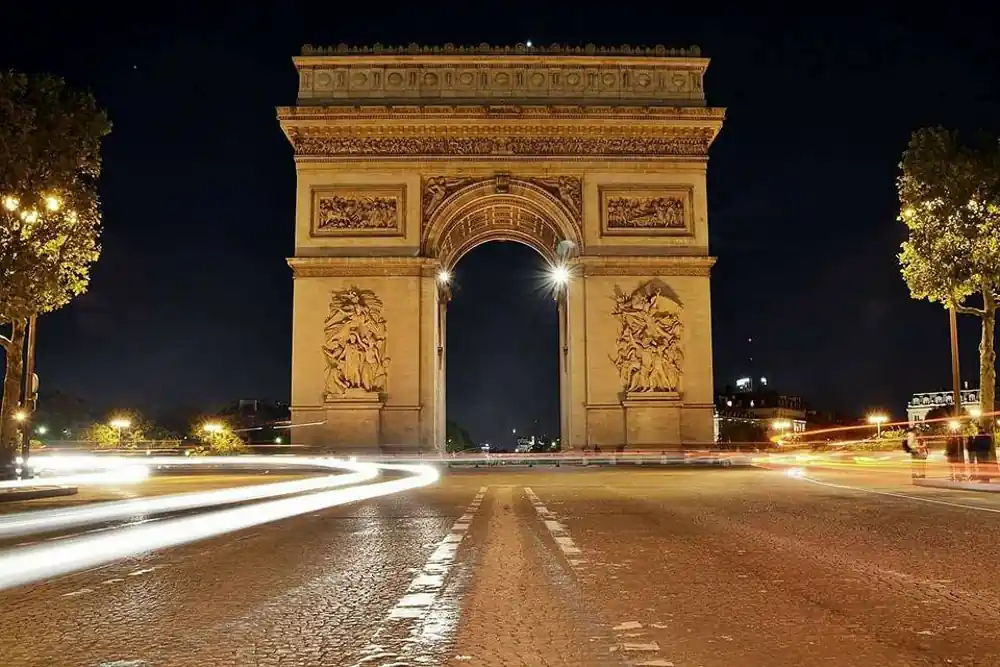
The Arc de Triomphe, standing proudly at the western end of the Champs-Élysées, is one of the most powerful and symbolic monuments in Paris, and a centerpiece of French national identity. Commissioned by Napoleon after his greatest victory, the arch captures the essence of French courage, military glory, and artistic mastery. Its massive form, rich bas-reliefs, and commanding location make it not just a monument, but a story carved in stone.
The Origin: Napoleon’s Dream of Eternal Glory
The Arc de Triomphe was ordered by Napoleon Bonaparte in 1806 after his decisive victory at the Battle of Austerlitz, considered one of the greatest military triumphs in European history. His vision was clear:
“You will go home under triumphal arches.”
Napoleon wanted Paris to have an arch equal to those of ancient Rome, symbolizing the might of the French army and the unity of the nation under his leadership.
The construction took 30 years, spanning different political regimes: the Empire, the Restoration, and the July Monarchy. It was finally completed in 1836 under King Louis-Philippe, who dedicated it to the armies of the Revolution and the Empire.
A Monument of Immense Scale
Visitors are often surprised by the sheer size of the Arc de Triomphe:
Its scale dominates the center of Place Charles-de-Gaulle, formerly Place de l’Étoile, where 12 grand avenues converge in a star-shaped pattern-a plan designed by Baron Haussmann during Paris’s 19th-century transformation.
This makes the Arc de Triomphe the dramatic heart of western Paris and the symbolic gateway to the Champs-Élysées.
The arch is covered in monumental sculptures—living stories in stone, each representing key moments of French history.
✓ The Departure of the Volunteers (La Marseillaise)
Carved by François Rude, this is the most famous sculpture. A powerful female figure, representing Liberty, urges volunteers into battle. The energy, emotion, and dramatic movement make it one of the masterpieces of French Romantic sculpture.
✓ The Triumph of 1810
By Jean-Pierre Cortot, celebrating Napoleon crowned as a peacemaker.
✓ The Resistance of 1814
By Antoine Etex, honoring the French resistance against invasion.
✓ The Peace of 1815
Also by Etex, symbolizing the end of the Napoleonic Wars and the return to peace.
Across the top of the monument and inside the vault, you will also find:
This makes the Arc de Triomphe a huge outdoor encyclopedia of French military history.
Since 1920, the Arc de Triomphe has housed the Tomb of the Unknown Soldier, representing all French soldiers who died in World War I without their identity ever being known.
An eternal flame, lit in 1923, burns at the tomb. Every evening at 6:30 PM, the flame is rekindled in a moving ceremony carried out by veteran associations. This makes the Arc de Triomphe one of the most sacred modern memorials in France.
The Arc de Triomphe is the focal point of France’s most important national ceremonies:
✓ Bastille Day Military Parade (14 July)
France’s national holiday begins with troops descending from the Arc to the Place de la Concorde.
✓ Armistice Day (11 November)
The President of France lays a wreath at the Tomb of the Unknown Soldier.
✓ Tour de France Finale
Cyclists race past the Arc de Triomphe in a spectacular global event.
✓ New Year’s Eve Light Shows
The monument becomes a projection screen for breathtaking visuals and fireworks.
It is also illuminated in different colors to honor world events and solidarity movements.
Visitors who climb the 284 steps (or take the elevator partway) reach a platform offering a unique circular view of Paris:
Few viewpoints capture the architectural harmony of Paris as beautifully as the Arc de Triomphe.
Stories, Legends & Symbolism
The Arc de Triomphe is associated with unforgettable historical episodes:
The Funeral Procession of Napoleon (1840)
Napoleon’s remains passed under the arch when they were returned from Saint Helena to Paris.
Victory Marches
The Miniature Arc de Triomphe in Pyongyang
As a testament to its influence, North Korea built the world’s second-largest triumphal arch inspired directly by Paris’s iconic monument.
Visiting the Arc de Triomphe – A Must for Every Paris Traveler
The Arc de Triomphe is more than a stop—it’s a centerpiece of any Paris tour. Visitors can:
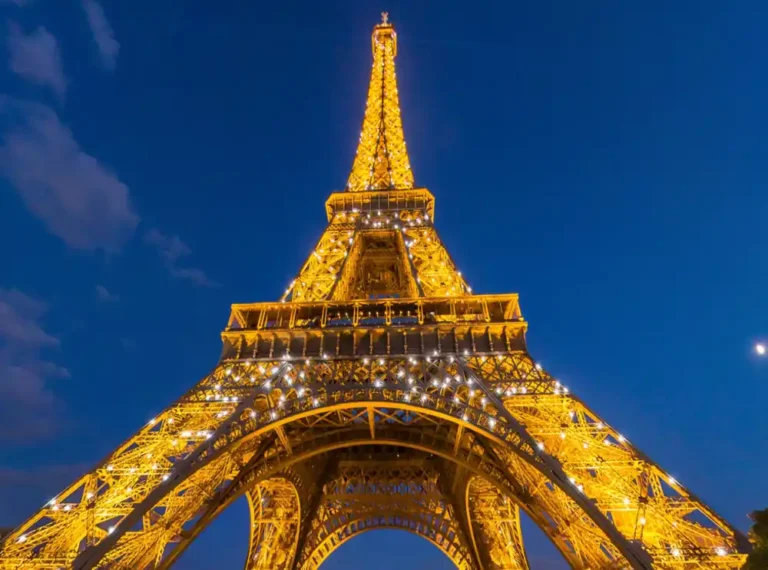
The Eiffel Tower-or La Tour Eiffel-is not just a monument; it is the beating heart of Paris, the global symbol of France, and one of the most recognized architectural achievements in human history. Rising proudly above the Parisian skyline, the Eiffel Tower attracts millions of visitors every year, making it an essential destination for any guided tour of Paris.
A Vision of Iron and Innovation
Built for the Exposition Universelle of 1889, the Eiffel Tower was designed by the brilliant engineer Gustave Eiffel and his team, including architect Stephen Sauvestre and engineers Émile Nouguier and Maurice Koechlin. Created to commemorate the 100th anniversary of the French Revolution, the tower became a symbol of France’s industrial progress, scientific brilliance, and artistic imagination.
When it opened, the Eiffel Tower stood as the tallest structure in the world at 300 meters (984 feet), surpassing every building and monument before it. Even today, it remains a masterpiece of iron architecture and a marvel of engineering innovation.
Structure That Redefined Architecture
The Eiffel Tower is composed of 18,038 individual iron pieces and over 2.5 million rivets, demonstrating the precision and creativity of 19th-century engineering. Its elegant lattice structure, initially criticized by artists and intellectuals, now embodies the spirit of Parisian modernity.
Key facts that impress visitors during guided tours:
The tower’s unique design ensures stability against wind and temperature changes, causing it to grow or shrink up to 15 cm depending on the weather.
Visiting the Eiffel Tower – Three Levels of Wonder
Guided tours of the Eiffel Tower offer an unforgettable experience:
First Floor
Second Floor
Summit (Top Level)
Whether day or night, the views from the Eiffel Tower are unparalleled.
The Eiffel Tower at Night – Magic in Motion
Every evening, the Eiffel Tower transforms into a beacon of light:
This nightly spectacle makes evening tours of the Eiffel Tower especially popular among visitors seeking the most romantic views of Paris.
The Eiffel Tower Through History
The Eiffel Tower has played a crucial role in many chapters of Parisian and global history:
The tower has also appeared in countless films, novels, and artworks, becoming a universal icon.
Surroundings of the Eiffel Tower – The Heart of the 7th Arrondissement
The Eiffel Tower is surrounded by some of Paris’s most beautiful spaces:
Champ de Mars
One of the largest public gardens in Paris, ideal for picnic tours, photography sessions, and scenic walks.
Trocadéro
Across the Seine, the Trocadéro esplanade offers the best panoramic views of the Eiffel Tower—perfect for sunrise and nighttime photography.
Seine River Cruises
The Eiffel Tower is a highlight of many river cruises, offering a magical perspective from the water.
Guided tours can include combinations of tower visits, riverside strolls, museum stops, and local dining experiences.
Sustainable Paris – The Eiffel Tower Today
The Eiffel Tower is increasingly integrating modern sustainability solutions:
This commitment ensures that the tower remains both a historical treasure and a forward-thinking landmark.
Interesting Facts & Hidden Stories
Guides can share remarkable anecdotes:
These stories make guided tours immersive and unforgettable.
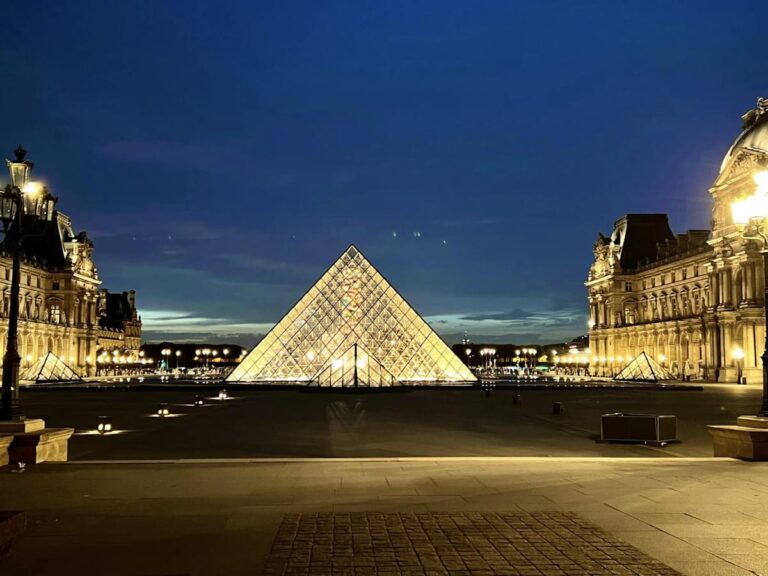
The Musée du Louvre is not only the most visited museum in the world-it is the beating heart of art, culture, and history in Paris. With a collection spanning over 9,000 years, masterpieces from every continent, and an architectural heritage rooted in French royalty, the Louvre is a monumental journey through time and imagination. For travelers, a guided tour of the Louvre is one of the most enriching and unforgettable experiences available in Paris.
The Louvre: From Fortress to the World’s Greatest Museum
Long before it became a museum, the Louvre was a medieval fortress built in 1190 by King Philippe Auguste to defend Paris from intruders arriving via the Seine River. Portions of this ancient fortress can still be seen today in the museum’s lower levels.
In the 16th century, it was transformed into a royal palace by King François I, a passionate patron of the arts who brought the Renaissance spirit to France. Over time, the Louvre was expanded by successive monarchs, including Louis XIV, before finally opening as a public museum in 1793, during the French Revolution.
Today, it houses over 38,000 artworks, from Greek antiquity to 19th-century masterpieces.
An Architectural Masterpiece: The Palace & The Pyramid
The Palace
The Louvre palace is a stunning combination of medieval, Renaissance, Baroque, and classical architecture. Its elegant courtyards, grand facades, and richly decorated halls reflect centuries of royal ambition and artistic grandeur.
The Glass Pyramid
In 1989, architect I. M. Pei unveiled the museum’s now-iconic Glass Pyramid. Its modern, minimalist design creates a breathtaking contrast with the historic palace.
Today, the pyramid acts as the main entrance and has become one of the most photographed symbols of Paris.
The Louvre Collections-A Journey Across Civilizations
The Louvre’s immense collection is divided into eight major departments, each offering visitors a window into the world’s artistic and cultural heritage.
Masterpieces That Define the Louvre
A guided tour of the Louvre highlights some of the world’s most celebrated artworks:
✓ Mona Lisa (La Joconde) – Leonardo da Vinci
The most famous painting on Earth, admired for her enigmatic smile and Leonardo’s unparalleled mastery. The Mona Lisa alone draws millions of visitors a year.
✓ Venus de Milo
This ancient Greek sculpture, dating to around 100 BCE, symbolizes the beauty and idealism of classical art.
✓ Winged Victory of Samothrace
A breathtaking marble sculpture perched atop a staircase, representing Nike, the Greek goddess of victory.
✓ Liberty Leading the People-Eugène Delacroix
A powerful symbol of revolution and freedom, celebrating the 1830 uprising in Paris.
✓ The Coronation of Napoleon-Jacques-Louis David
A monumental historical panorama, capturing Napoleon crowning himself Emperor.
✓ The Great Sphinx of Tanis
One of the most impressive Egyptian sculptures outside of Cairo.
These iconic works, among thousands of others, make the Louvre an extraordinary artistic universe.
Egyptian Antiquities – A Kingdom Reborn
The Louvre houses one of the largest Egyptian collections outside Egypt.
Guided tours bring these ancient treasures to life, explaining their symbolism, beliefs, and the fascinating world of the Nile civilizations.
Greek, Etruscan & Roman Antiquities
The Louvre’s classical collection is a monumental tribute to ancient Mediterranean cultures.
Highlights include:
This department illustrates the evolution of mythology, aesthetics, and early European civilizations.
Near Eastern Antiquities – Cradle of Civilization
Travelers can explore objects from:
Masterpieces such as the Code of Hammurabi, an early legal text, and monumental palace sculptures reveal the origins of writing, law, and urban life.
The Arts of Islam
The Louvre’s Islamic Arts wing, housed beneath a golden undulating roof, showcases over 1,000 years of art from Spain to India:
It is a carefully curated celebration of geometry, mathematics, and spiritual beauty.
European Paintings & Sculptures
The Louvre contains unparalleled collections of European masterpieces:
The sculpture galleries feature works like:
These collections make the Louvre an essential destination for art lovers.
Decorative Arts & Royal Apartments
Visitors can also explore:
These rooms offer insight into the elegance and artistry of French court life.
Louvre Museum Tours: Why They Are Essential
Navigating the Louvre’s 73,000 m² of galleries can be overwhelming. Guided tours offer:
This enhances the visitor experience, making the art accessible and engaging.
Surroundings of the Louvre-The Heart of Historic Paris
The Louvre is surrounded by iconic landmarks:
The neighborhood is perfect for photography, romantic walks, and cultural explorations.
Fascinating Stories & Anecdotes
Guides often share captivating legends:
The Stolen Mona Lisa (1911)
The Mona Lisa was stolen by an Italian handyman, and its disappearance made headlines worldwide. Ironically, this theft helped make the painting the global icon it is today.
Napoleon’s Bedroom in the Louvre
Few visitors know that Napoleon III’s apartments are still preserved inside the museum.
The Louvre’s Secret Tunnels
Underground corridors connect various wings — remains of the medieval fortress and access paths used by French royalty.
The Louvre During World War II
The museum staff evacuated thousands of artworks to protect them from Nazi theft. The Mona Lisa traveled across France, hidden in châteaux.
The Louvre Today – Innovation & Accessibility
The museum continuously evolves:
This ensures that every visit brings something new.
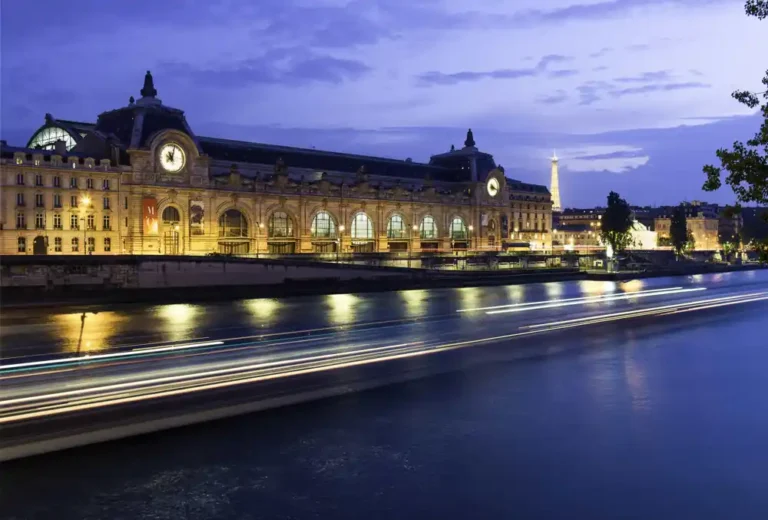
The Musée d’Orsay, located on the Left Bank of the Seine, is one of the most magnificent museums in Paris-and one of the most beloved art museums in the world. Housed in a breathtaking former railway station, the museum is a temple dedicated to Impressionism, Post-Impressionism, and 19th-century art, featuring masterpieces by Monet, Renoir, Degas, Van Gogh, Cézanne, Gauguin, and many others.
From Train Station to World-Class Art Museum
Before becoming an art museum, the building of the Musée d’Orsay was the Gare d’Orsay, an elegant Beaux-Arts train station inaugurated for the 1900 Exposition Universelle (World’s Fair). Designed by architects Lucien Magne, Victor Laloux, and Émile Bénard, it was considered one of the most modern stations of its time, equipped with electricity and cutting-edge technology.
By the 1930s, the station could no longer handle longer, modern trains. After decades of disuse and several possible redevelopment plans (including demolition!), the French government decided to transform it into a museum that would bridge the gap between the classical art of the Louvre and modern art of the Centre Pompidou.
In 1986, the Musée d’Orsay opened its doors, quickly becoming a global reference for 19th-century art.
A Masterpiece of Architecture: The Soul of the Museum
Walking into the Musée d’Orsay feels like stepping inside a majestic cathedral of light and creativity. The museum preserves the spectacular:
The harmony between old-world elegance and modern museum design makes the Musée d’Orsay one of the most stunning cultural spaces in Europe.
The Heart of the Collection – The Impressionists
The Musée d’Orsay is the world headquarters of Impressionism, housing the most important collection of Impressionist works on Earth.
Visitors can admire masterpieces by:
Pierre-Auguste Renoir
Edgar Degas
Camille Pissarro
Alfred Sisley
Édouard Manet
These paintings revolutionized the history of art, capturing light, nature, and everyday life in entirely new ways.
Post-Impressionism – Bold Colors and Emotional Power
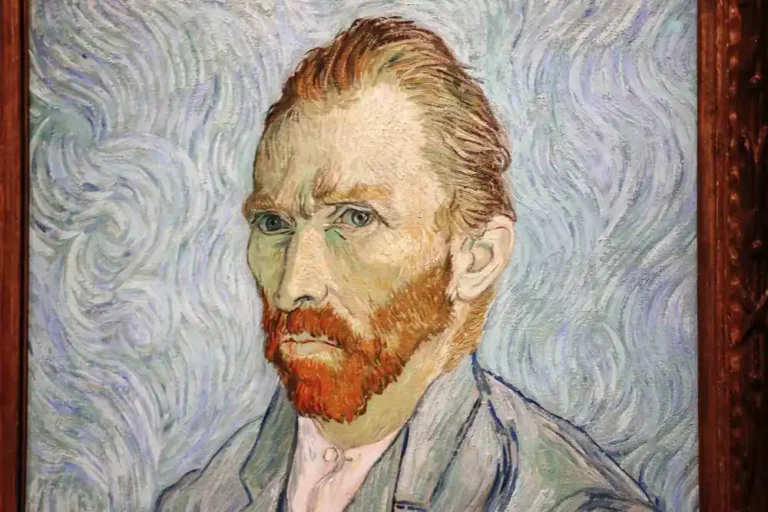
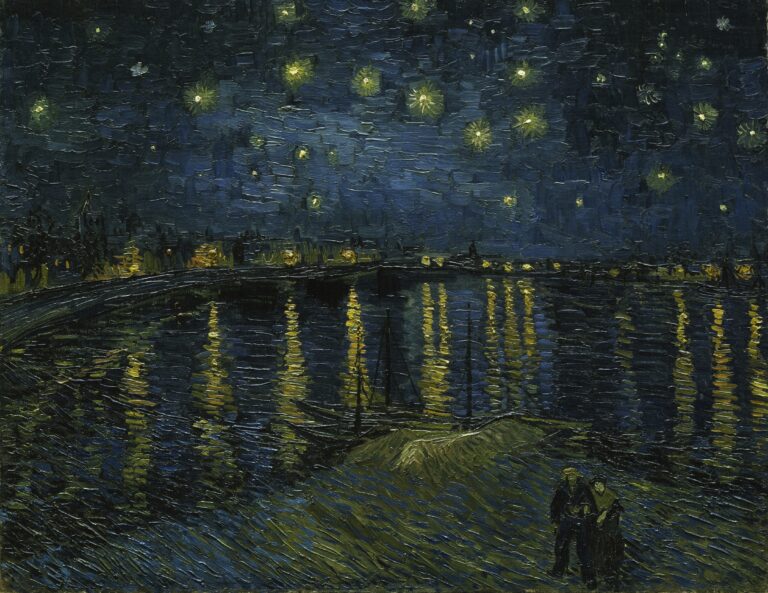
The Musée d’Orsay also showcases extraordinary Post-Impressionist masterpieces by the geniuses who pushed art into new emotional territories.
Vincent van Gogh
Paul Gauguin
Paul Cézanne
Henri de Toulouse-Lautrec
These halls show how artists broke away from tradition and reinvented how the world could be seen.
Sculpture, Decorative Arts & Photography
The Musée d’Orsay’s collections extend far beyond painting.
Sculptures
Displayed throughout the central nave and upper floors, the sculptures include:
Art Nouveau & Decorative Arts
Furniture, glasswork, and interior designs by artists such as:
These collections highlight the birth of modern design.
Early Photography
The museum also honors the pioneers of photography, offering a deep look into the origins of visual culture.
The Great Clock – A Symbol of Paris
The museum’s massive clock windows—left from its days as a train station—have become one of the most photographed viewpoints in Paris. From behind the transparent clock, visitors can see the Seine, the Louvre, and the rooftops of the Right Bank.
Essential Works Not to Miss
A well-designed guided tour will highlight major masterpieces, including:
Even visitors with limited time can enjoy a curated selection of iconic artworks with expert explanations.
Why Visit the Musée d’Orsay With a Guided Tour?
Because the Musée d’Orsay offers:
A guided tour transforms a visit into a full cultural experience.
The Surroundings – Paris at Its Most Beautiful
The Musée d’Orsay sits in the elegant 7th arrondissement, surrounded by top attractions:
This area of Paris is ideal for culture-rich walking tours.
Fascinating Stories & Facts to Share on Tours
These stories enrich the visitor experience and make the art feel alive.
The Palace of Versailles (Château de Versailles) is more than a royal residence-it is a living chronicle of French history, a stage upon which the destiny of Europe unfolded, and one of the most extraordinary achievements in architecture, art, and political symbolism. Located just 20 km from Paris, Versailles is a masterpiece of power, beauty, and ambition, attracting millions of visitors every year. For travelers, a guided tour of Versailles is an immersive journey through centuries of kings, queens, revolutions, wars, and world-changing events.
The Early Origins – From Swampy Hunting Grounds to Royal Territory
Before it became a palace, Versailles was a humble village, surrounded by forests and marshland. The area had little importance until Louis XIII, father of Louis XIV, built a small stone and brick hunting lodge in 1623.
He expanded it in 1631, turning the site into a secluded refuge where he could escape the intrigues and tensions of Paris and the Louvre. This lodge would later become the nucleus of the immense palace we know today.
Louis XIV – The Sun King Who Transformed France
The true story of Versailles begins with Louis XIV (1638–1715), one of the longest-reigning monarchs in history. Coming to power at age four, he lived through the Fronde, a series of noble rebellions that traumatized him and shaped his ideals.
Louis XIV emerged determined to:
Versailles was the perfect tool for these ambitions.
Building the Palace – 50 Years of Triumphs, Challenges & Innovations
From 1661 until his death in 1715, Louis XIV transformed the modest lodge into the most spectacular palace in Europe. The project involved:
Key architects & artists:
Construction took place in phases, often interrupted by wars and economic crises. Yet the palace grew larger and more majestic year after year.
Versailles as the Seat of Absolute Monarchy
In 1682, Louis XIV officially moved the royal court and government to Versailles.
This was a radical political strategy:
Versailles was not just a residence – it was a political machine. The king’s rising, dining, and retiring routines (lever, coucher) became elaborate ceremonies that nobles fought to participate in.
The Hall of Mirrors – The Power of the Sun King
The Hall of Mirrors (1678–1684) is the masterpiece of Versailles and one of the most iconic rooms in the world.
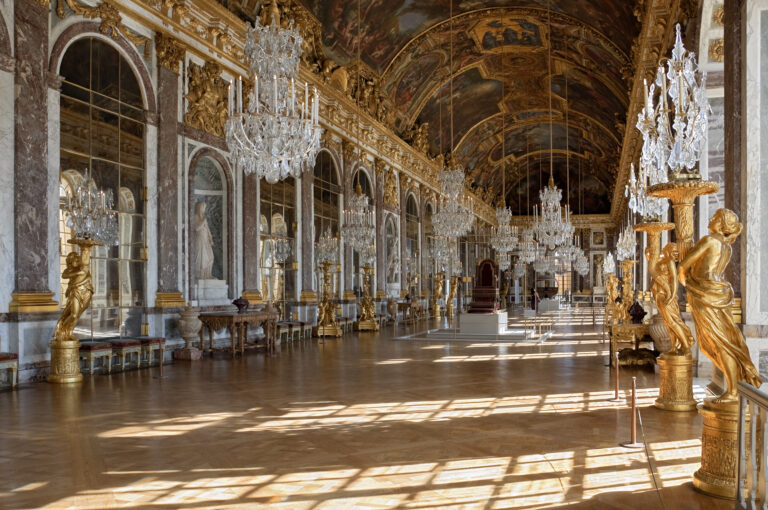
Why it mattered:
Historic moments in the Hall of Mirrors:
Versailles has witnessed both France’s greatest glory and its most painful defeats.
Life at Court – Ceremony, Culture & Intrigue
Court life at Versailles was highly structured:
Daily rituals
Culture
Versailles became a cultural magnet, attracting geniuses like:
Intrigues
The rigid court structure also fueled jealousy and political plotting. Stories of rivalry between nobles, mistresses, and advisers are a major highlight of guided tours.
The Gardens – Nature Sculpted Into Majesty
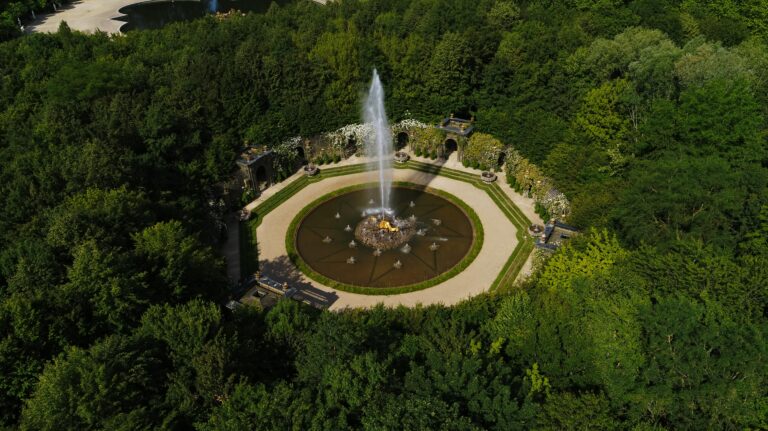
Covering over 800 hectares, the Gardens of Versailles are as important as the palace itself. Designed by André Le Nôtre, the gardens required massive earthworks-hills were leveled, lakes drained, and forests moved.
The gardens feature:
Fountain Shows
Louis XIV used water as a symbol of power. During his era, servants manually operated fountains when the king approached. Today, musical fountain shows recreate this royal spectacle.
The Grand & Petit Trianon – Royal Escapes
Grand Trianon
Built in 1687, the Grand Trianon was Louis XIV’s private retreat, far from the rigid court life. Its pink marble columns and elegant gardens embody delicacy and intimacy.
Petit Trianon
Constructed under Louis XV and famously associated with Marie-Antoinette, who used it as her sanctuary. Here, she enjoyed privacy, hosted select guests, and lived more freely.
Marie-Antoinette & The Queen’s Hamlet
Marie-Antoinette, often misunderstood, preferred intimacy over the rigid traditions of Versailles. She built the Queen’s Hamlet (Hameau de la Reine) – an idealized rural village with:
It was her place of escape from court pressures, just before the storm of the French Revolution.
The End of Royal Versailles-Revolution & Abandonment
By 1789, France was in crisis. The French Revolution erupted and:
Many furnishings were sold, and the palace suffered heavy damage and neglect.
Versailles Reborn-Museum of the History of France
In 1837, King Louis-Philippe transformed Versailles into a museum dedicated to “all the glories of France.” Massive renovations restored the palace and created historical galleries celebrating military, political, and cultural achievements.
Versailles in Modern History & Today
Versailles continued to make history:
Today it is a UNESCO World Heritage site and one of France’s greatest cultural treasures.
Why Guided Tours Make Versailles Magical
Versailles is enormous and filled with stories. Guided tours help visitors:
Guides bring centuries of royal life to vivid, unforgettable clarity.
Welcome to ProgramTickets!
Let us know how we may assist you and we'll be back as soon as possible.
Please note that our business hours is 09:00 - 17:00 Paris time.
WhatsApp us

Discover the World with our local guides!
Laca Novomeského 2909/20, Kolárovo
946 03, Slovakia
info@programtickets.com
Travel Agency +1 473 483 384
Info Insurance +1 395 393 595


