

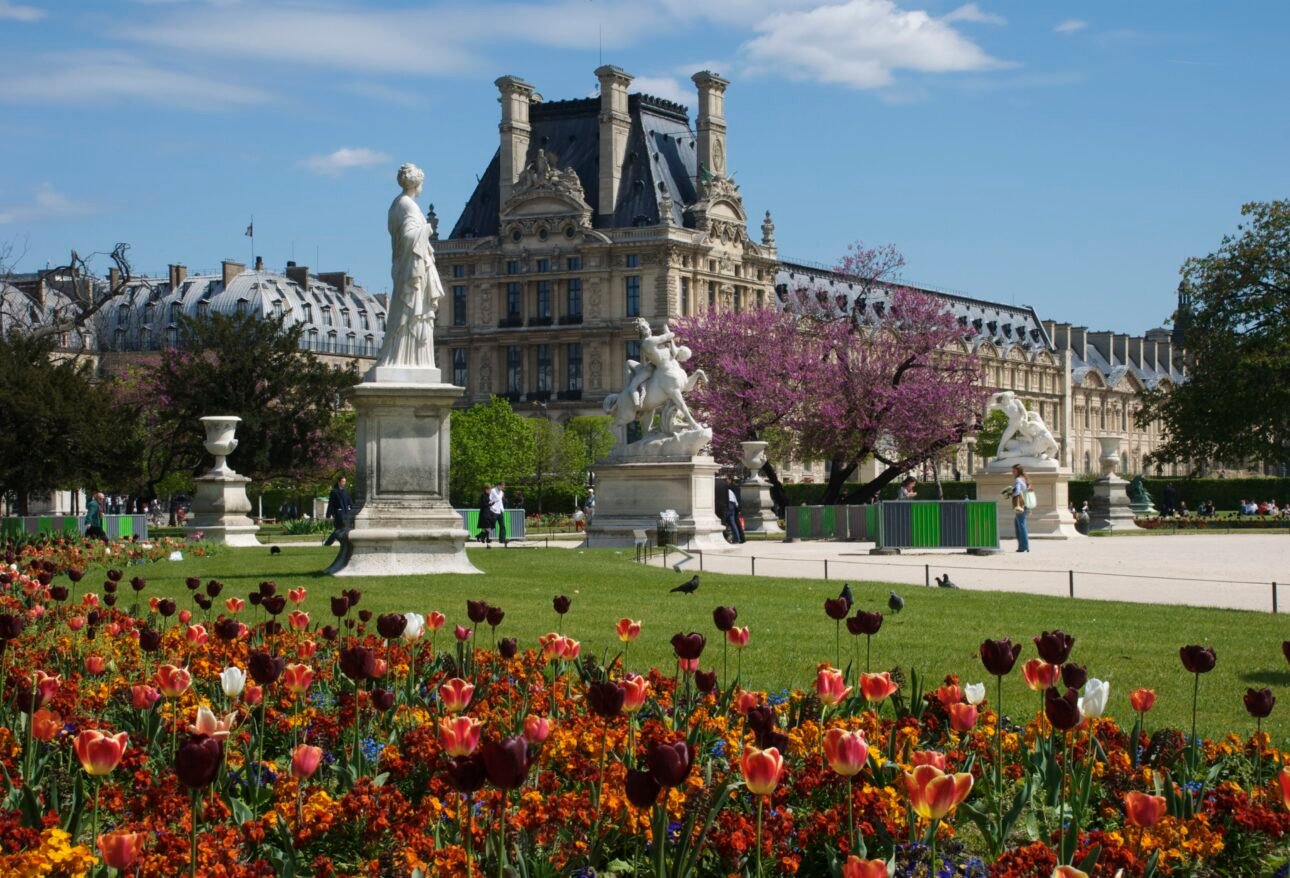
Somewhere between the golden galleries of the Louvre and the grand, obelisk-marked sweep of Place de la Concorde lies a stretch of green that has quietly watched over Paris for more than 450 years. The Tuileries Garden isn’t just scenery you pass through on your way to somewhere else – it’s a living chapter of French history, art, and everyday joy, laid out across 28 perfectly symmetrical hectares of chestnut trees, fountains, and gravel paths. Whether you’re chasing the perfect photograph, hunting for a quiet bench to eat a croissant, or simply curious why every Parisian seems to have a favorite corner of this particular garden, the Tuileries Garden rewards anyone willing to slow down and look closely.
This guide walks you through the history, the design, and the twelve small experiences that make the Tuileries Garden one of the most quietly magical places in all of Paris – plus everything you need to know before you go.
A Brief History of the Tuileries Garden
Long before it became a garden, this stretch of land on the right bank of the Seine was a clay quarry. Workshops here fired the roof tiles – “tuiles” in French – that eventually gave the whole neighborhood its name. That humble, practical history changed forever in 1564, when Catherine de’ Medici, recently widowed after the death of King Henry II, commissioned a grand new residence on the site: the Tuileries Palace. Homesick for the landscapes of her native Florence, she had an Italian-style garden laid out beside it, complete with an orangery for citrus trees and even a small silk farm.
The garden most visitors walk through today, however, owes its true character to one man: André Le Nôtre, the celebrated royal gardener who would go on to design the grounds of Versailles. In 1664, under Louis XIV and his minister Jean-Baptiste Colbert, Le Nôtre completely reimagined Catherine de’ Medici’s garden, trading its Italian romanticism for the rigorous symmetry, long sightlines, and geometric parterres that define French classical garden design. It’s Le Nôtre’s vision – the ruler-straight central avenue, the perfectly aligned ponds, the sense that the entire garden has been arranged around one grand perspective – that still shapes every walk through the Tuileries Garden today.
Remarkably, the garden opened its gates to the public in 1667, making it one of the very first royal gardens in France to welcome ordinary citizens and arguably Paris’s oldest public park. In the centuries since, it has witnessed nearly every major turn in French history: revolutionary crowds gathered on its lawns, soldiers camped beneath its trees, and in 1871, the Tuileries Palace itself was burned to the ground during the uprising of the Paris Commune and was never rebuilt. The garden, remarkably, survived when the palace didn’t – and has spent the century and a half since becoming something arguably more valuable than a royal backdrop: a shared, democratic green space where Parisians of every background come to think, rest, and simply breathe.
Where Is the Tuileries Garden Located?
The Tuileries Garden sits in the 1st arrondissement of Paris, forming a green corridor nearly a kilometer long between two of the city’s most recognizable landmarks. On its eastern edge, it meets the Louvre; on its western edge, it opens directly onto Place de la Concorde. The Seine runs along its southern border, while the elegant arcades of Rue de Rivoli line it to the north.
Getting there could hardly be easier. The Tuileries metro station (Line 1) drops you at the garden’s eastern half, while Concorde (Lines 1, 8, and 12) puts you right at its western entrance. If you’re coming from inside the Louvre, you can simply walk out through the Arc de Triomphe du Carrousel and you’re already standing in the garden. Because it sits at the heart of the city’s most walkable district, most visitors actually stumble into the Tuileries Garden while heading somewhere else entirely – and end up staying far longer than they planned.
The Timeless Design of the Tuileries Garden
What makes the Tuileries Garden so visually satisfying, even to visitors who know nothing about garden history, is its sense of order. Le Nôtre designed the garden along a strict east–west axis, with paths, hedges, statues, and ponds arranged in mirrored symmetry around a central avenue. Stand in exactly the right spot and you can see clear across the garden, through the Arc de Triomphe du Carrousel, all the way up the Champs-Élysées to the Arc de Triomphe in the distance.
Today the garden is generally understood as three connected spaces. Closest to the Louvre sits the Carrousel Garden, a smaller and more intimate area anchored by the Arc de Triomphe du Carrousel, Napoleon’s miniature triumphal arch. Moving west, the Grand Couvert is the shadiest and most romantic stretch -. a dense grove of chestnut and lime trees that turns gold in autumn, centered on the large circular pond known as the Grand Bassin Rond. Finally, the Grand Carré, nearest to Place de la Concorde, opens into wide gravel paths, manicured lawns, and an octagonal basin framed by terraces of roses and lavender.
Even the plantings feel curated rather than incidental: rows of chestnut, lime, and elm trees still follow the disciplined geometry Le Nôtre laid out more than 350 years ago. It’s a garden built to be looked at as much as walked through, and every year it also plays host to rotating outdoor sculpture exhibitions and even the occasional Paris Fashion Week show – proof that this centuries-old layout still has room for something new. That deliberate, layered intentionality is exactly why the Tuileries Garden still feels so different from an ordinary city park.
12 Magical Things to See and Do in the Tuileries Garden
The Tuileries Garden rewards visitors who go beyond a quick walk-through. Here are twelve experiences – some famous, some easy to miss – that capture what makes this garden so special.
1. Stroll Beneath the Chestnut Trees of the Grand Couvert
The Grand Couvert’s canopy of chestnut and lime trees is the closest thing Paris has to a fairy-tale forest. In spring, the chestnuts bloom in candle-like white flowers; in autumn, the ground turns into a carpet of gold and amber. Even in the height of summer, this shaded stretch stays noticeably cooler than the open plazas nearby.
2. Claim a Green Chair by the Water
Few images are more instantly Parisian than the garden’s dark-green metal chairs, scattered loosely around the ponds. There’s no fee and no reservation – you simply pick one up, carry it to whatever patch of sun or shade suits you, and sit. Watching the light shift over the water while Parisians read, nap, and chat around you is, for many visitors, the single most memorable part of any trip to the Tuileries Garden.
3. Marvel at the Maillol Sculptures in the Carrousel Garden
In 1964, at the urging of Minister of Culture André Malraux and thanks to a donation from Dina Vierny, around twenty bronze sculptures by Aristide Maillol were installed throughout the Carrousel Garden. Maillol’s smooth, monumental female forms – including pieces like “Méditerranée” and “The Three Graces” – turned this corner of the Tuileries Garden into one of the most significant open-air sculpture collections anywhere in the world, and they remain free to admire any hour the gates are open.
4. Track Down Rodin’s Hidden “The Kiss”
Tucked into a quiet, shaded corner of the garden, easy to walk right past, sits a bronze cast of Rodin’s “The Kiss” (Le Baiser) – one of the most famous sculptures ever made, displayed here with almost no fanfare at all. Finding it feels like being let in on a secret that most visitors to the Tuileries Garden never discover.
5. Step Inside the Musée de l’Orangerie
Tucked into the garden’s southwest corner, right where it meets the Seine, the Musée de l’Orangerie occupies a former hothouse that once sheltered the palace’s orange trees through winter. Inside, two oval rooms hold Claude Monet’s monumental “Water Lilies” panels, painted specifically for this space, alongside a superb collection of works by Cézanne, Renoir, Matisse, and Modigliani. It’s a separate, ticketed museum, but it sits so naturally within the Tuileries Garden that visiting feels like a continuation of the walk itself.
6. Explore Contemporary Photography at the Jeu de Paume
Facing the Orangerie from the garden’s northwest corner, the Jeu de Paume occupies a nineteenth-century pavilion originally built for the historic ball-and-paddle game of the same name. Today it’s one of Europe’s leading spaces for photography and moving-image art, giving the Tuileries Garden a genuinely contemporary artistic pulse alongside its centuries-old classical bones.
7. Watch Toy Sailboats Drift Across the Ponds
Near the garden’s ponds, you can rent small wooden sailboats and nudge them across the water with a long stick – a tradition that has delighted Parisian children, and more than a few adults, for generations. It’s a small, unhurried pleasure that captures the whole spirit of the Tuileries Garden in miniature.
8. Pass Beneath the Arc de Triomphe du Carrousel
Commissioned by Napoleon to celebrate his military victories and modeled on the triumphal arches of ancient Rome, this smaller, pink-marble arch once served as the ceremonial gateway to the Tuileries Palace. Standing beneath it and looking west gives you one of the most breathtaking sightlines in Paris – straight through the garden, up the Champs-Élysées, to the Arc de Triomphe in the distance.
9. Watch the Paris Cauldron Balloon Rise at Sunset
One of the newest and most unexpectedly magical additions to the Tuileries Garden is the Paris Cauldron – the flame-free, electrically powered balloon and ring of fire that first captivated the world during the 2024 Olympic Games. Tethered above the Grand Bassin Rond, it now returns each summer, generally from late June through mid-September, rising gracefully into the sky at sunset as a nod to the very first hydrogen balloon flight, which launched from this exact spot back in 1783. It’s completely free to watch, and there’s genuinely nothing else quite like it anywhere in Paris.
10. Wander the Tuileries Christmas Market
Every winter, from mid-November into early January, the western end of the Tuileries Garden transforms into one of the city’s largest and liveliest Christmas markets, complete with a towering Ferris wheel offering views toward the Eiffel Tower, an ice rink, carnival rides, and stalls selling mulled wine and roasted chestnuts. It’s a completely different mood from the garden’s quiet summer self – but no less enchanting.
11. Frame the Perfect Photograph
Because the entire garden is built along Le Nôtre’s single grand axis, almost any spot along the central avenue offers a postcard-worthy view — the Louvre’s glass pyramid glinting behind you, the obelisk of Place de la Concorde ahead, even the Eiffel Tower peeking over the treetops to the south. Golden hour, especially in late spring, turns the whole garden into a soft, romantic haze.
12. People-Watch Like a True Parisian
Ultimately, the simplest thing to do in the Tuileries Garden might also be the best: find a chair, sit facing the water, and watch the city drift by. Joggers, chess players, sketch artists, parents chasing toddlers, couples on first dates – the Tuileries Garden has been Paris’s shared living room for more than 350 years, and it still plays that role today.
Best Time to Visit the Tuileries Garden
Because the Tuileries Garden changes its personality with the seasons, when you visit shapes what kind of experience you’ll have.
Spring (April-May) is arguably the garden’s most photogenic season, when the chestnut trees blossom and the flowerbeds around the Grand Carré burst into color. Mornings are especially peaceful, with crowds rarely arriving before early afternoon.
Summer (June-August) brings the longest opening hours of the year – as late as 11 pm on some evenings – plus the season’s headline event: the Paris Cauldron balloon lifting off each evening at sunset. It’s also the busiest and warmest stretch of the year, so an early-morning or after-dinner visit helps you dodge both the heat and the crowds.
Autumn (September- October) dresses the Grand Couvert in gold and amber and brings noticeably softer light for photography, with far fewer tourists than the summer months.
Winter (November- March) transforms the western end of the garden into the Tuileries Christmas Market, complete with a Ferris wheel and ice rink, while the rest of the garden settles into a stark, elegant quiet that has its own kind of charm – especially on a crisp, clear morning.
Whatever the season, arriving right at opening time or in the hour before closing tends to give you the Tuileries Garden at its most peaceful and most photogenic.
Practical Tips for Visiting the Tuileries Garden
It’s completely free. There’s no ticket, no reservation, and no time limit for entering the Tuileries Garden itself – only the two museums inside it, the Orangerie and the Jeu de Paume, require separate paid admission.
Check the seasonal hours before you go. The garden opens at 7 am (7:30 am in the depths of winter) year-round, but closing times shift from around 7:30 pm in winter to as late as 11 pm in summer, so it’s worth a quick check if you’re planning an evening visit.
Wear comfortable shoes. The paths throughout the Tuileries Garden are gravel rather than pavement, and the garden is large enough that a proper visit easily covers a few kilometers of walking.
Bring a picnic. Many of the lawn areas welcome picnickers, and grabbing a sandwich and pastry from a nearby boulangerie before settling onto the grass – or into one of those green chairs – is one of the most quietly Parisian things you can do.
Use the free public restrooms. Two public toilets are available inside the garden during opening hours, which is handy to know if you’re planning to settle in for a while.
Give yourself real time. Cutting straight through takes twenty to thirty minutes, but properly exploring the Tuileries Garden – the sculptures, the ponds, a coffee, a rented chair – is easily a one- to two-hour experience, or longer.
Combine it with the Louvre. Because the garden sits directly against the museum’s western wing, it’s the natural place to decompress after, or gather your thoughts before, a Louvre visit.
Nearby Attractions Worth Exploring
The Tuileries Garden’s location means it’s rarely a standalone stop – it’s the connective tissue between some of the greatest sights in Paris.
To the east, the Louvre needs no introduction; its glass pyramid is visible from much of the garden’s Carrousel section. To the west, Place de la Concorde unfolds around its ancient Egyptian obelisk, with the Champs-Élysées stretching beyond it toward the Arc de Triomphe. Just across the Seine, the pedestrian Passerelle Léopold-Sédar-Senghor footbridge leads directly to the Musée d’Orsay, making it entirely possible to walk from one collection of Impressionist masterpieces to another – the Orangerie, inside the Tuileries Garden itself – without ever hailing a taxi. To the north, the arcaded shops and cafés along Rue de Rivoli offer an easy spot to warm up with a coffee or browse for souvenirs.
Few gardens anywhere in the world sit at the intersection of so many essential landmarks, which is exactly why the Tuileries Garden works as well as a five-minute shortcut as it does as a half-day destination in its own right.
Why the Tuileries Garden Deserves a Place on Your Paris Itinerary
It would be easy to treat the Tuileries Garden as scenery – a pretty backdrop between the Louvre and Concorde, worth one photo and not much more. But spend even a single unhurried hour here, and it becomes obvious why generations of Parisians have kept coming back: this is a garden built on the scale of history yet designed for the rhythm of ordinary life. Kings commissioned it, revolutions passed through it, and yet its favorite residents have always been the joggers, the readers, the toddlers chasing pigeons, and the couples who claimed two green chairs and let the whole afternoon quietly disappear.
Whether you come for André Le Nôtre’s four-hundred-year-old symmetry, for Monet’s water lilies just off its southwest corner, for a balloon rising into a summer sunset, or simply for a quiet bench between the Louvre and the Seine, the Tuileries Garden has a way of making even a short visit feel like something you’ll remember for years. Few places in Paris ask so little of you and give back so much in return – which might be the truest definition of magic this city has to offer.