Gothic Quarter Barcelona
Few neighborhoods on earth can claim to hold two thousand years of continuous history within a space you can comfortably explore in a single morning. The Gothic Quarter Barcelona, known locally as the Barri Gòtic, is exactly that kind of place: a labyrinth of narrow medieval lanes, sunlit squares, and stone facades that have watched over the city since the Romans first laid out its walls. Walking through it does not feel like sightseeing so much as time travel, and that is precisely why the self-guided audio walking tour "The Barri Gòtic, Stop by Stop" has become one of the most rewarding ways to experience the heart of Barcelona.
This is not a rushed, guide-with-a-flag kind of tour. It is an intimate, at-your-own-pace journey covering roughly two kilometers on foot and ten unforgettable landmarks, all woven together into a single continuous loop that takes about sixty minutes to complete. Armed with nothing more than an MP3 audio guide and an interactive Google Map with turn-by-turn directions, you become the author of your own Barcelona story, free to linger at a favorite corner, snap photos of a hidden courtyard, or simply sit on a sun-warmed step and let the centuries wash over you.
Below, we take you stop by stop through this remarkable route, and explain exactly why the Gothic Quarter Barcelona deserves a prime spot on every traveler's itinerary.
Why the Gothic Quarter Barcelona Captivates Every Visitor
Before diving into the itinerary, it helps to understand what makes this neighborhood so special. The Gothic Quarter Barcelona is the oldest part of the city, built atop the Roman settlement of Barcino, which was founded roughly two thousand years ago. Over the centuries, Romans, Visigoths, medieval merchants, and modern architects have all left their fingerprints here, creating a dense, layered urban fabric where a first-century column might sit just meters from a nineteenth-century lamppost designed by a young Antoni Gaudí.
Unlike Barcelona's grand, wide boulevards elsewhere in the city, the Gothic Quarter is a maze of shaded alleyways that open unexpectedly into breathtaking plazas. It rewards curiosity and slow wandering, which is exactly why an audio-guided, self-paced format suits it so well. Instead of being herded through with a group, you can pause wherever the story catches you, whether that is a Roman wall, a Gothic bridge, or a square still scarred by twentieth-century conflict.
Stop 1: Plaça Nova and the Roman Walls
The journey begins at Plaça Nova, one of the oldest public squares in the city and the perfect threshold into the Gothic Quarter Barcelona. Here, towering fragments of the original Roman city walls still stand, a powerful reminder that this was once the fortified boundary of Barcino. Two cylindrical Roman towers flank the square, their weathered stone blocks having withstood two millennia of wind, rain, and history. Standing here, it is remarkable to realize that everything you are about to explore existed, in some form, when this wall marked the edge of civilization in this corner of the Mediterranean.
The audio guide sets the scene beautifully at this first stop, painting a picture of what Roman Barcino would have looked like: a modest but strategically important settlement, its grid of streets still faintly echoed in the layout of the modern old city. From here, the route draws you deeper into the quarter, toward its spiritual and architectural centerpiece.
Stop 2: Barcelona Cathedral
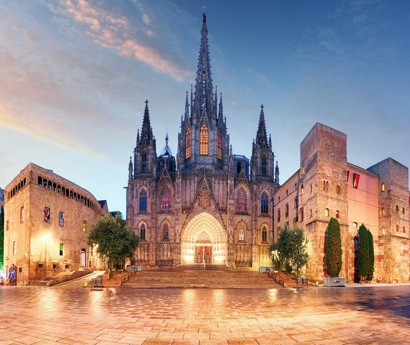
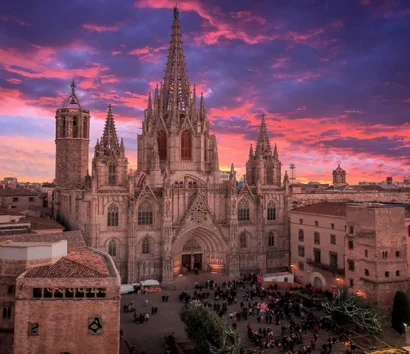
No exploration of the Gothic Quarter Barcelona would be complete without standing before the Barcelona Cathedral, formally known as the Cathedral of the Holy Cross and Saint Eulalia. Its soaring neo-Gothic facade, completed in the late nineteenth and early twentieth centuries though the core of the building dates back to the thirteenth and fourteenth centuries, is one of the most photographed sights in the entire city.
But the real magic lies inside, in the tranquil cathedral cloister. Here, amid palm trees and a moss-covered fountain, you will find a small flock of resident white geese, a tradition believed to date back centuries and tied to legends of Saint Eulalia, the city's co-patron saint. The number of geese is said to represent her age at the time of her martyrdom. It is a wonderfully unexpected, almost whimsical detail tucked inside one of Barcelona's most solemn religious buildings, and the audio guide brings this legend to life as you stand in the cloister listening to the geese honk softly beneath centuries-old stone arches.
Stop 3: Pont del Bisbe (Bishop's Bridge)
From the cathedral, the route leads to what may be the single most photographed spot in the entire Gothic Quarter Barcelona: the Pont del Bisbe, or Bishop's Bridge. This elegant, ornately carved stone bridge stretches across Carrer del Bisbe, connecting two historic buildings above the heads of passersby.
Here is a detail that surprises almost every visitor: despite its unmistakably medieval appearance, complete with tracery windows and a skull-and-dagger carving underneath, the bridge is not medieval at all. It was actually built in 1928 by architect Joan Rubió i Bellver as part of a Gothic Quarter Barcelona beautification project ahead of the 1929 International Exposition. It is, in effect, a beautifully executed piece of romantic historicism, designed to look centuries older than it actually is. This story is one of the highlights of the audio tour, because it playfully upends visitor assumptions and reveals how much of what feels ancient in Barcelona was, in fact, carefully curated in the twentieth century to enhance the city's medieval character.
Stop 4: Plaça de Sant Felip Neri
Just a short walk away lies one of the most poignant stops on the entire route: Plaça de Sant Felip Neri. At first glance, this small, quiet square, with its Baroque church and gently trickling fountain, feels like one of the most peaceful corners of the Gothic Quarter Barcelona. Children play here, students sketch the facades, and the square has become a beloved filming location for its picturesque charm.
But look closely at the church facade, and you will see something sobering: dozens of pockmarks and scars scattered across the stone. These are the remnants of a bombing raid in January 1938, during the Spanish Civil War, when the square was struck and dozens of people, many of them children sheltering nearby, lost their lives. The contrast between the square's serene beauty today and the violence of its past is deeply moving, and the audio guide handles this history with the sensitivity it deserves, ensuring visitors understand the full weight of the space they are standing in.
Stop 5: Plaça de Sant Jaume
From quiet reflection, the tour moves to the political heart of the city: Plaça de Sant Jaume. This grand square has been the center of civic and political power in Barcelona for centuries and continues to be so today. On one side stands the Palau de la Generalitat, seat of the Catalan regional government, and directly across from it, the Barcelona City Hall (Ajuntament de Barcelona).
Remarkably, this square sits almost exactly on the site of the old Roman forum, meaning that political life has been conducted on this precise spot for roughly two thousand years. The audio guide draws this connection vividly, helping visitors appreciate that Plaça de Sant Jaume is not just a pretty public square but a living thread connecting Roman Barcino to twenty-first-century Catalonia.
Stop 6: Temple of Augustus
Just off the beaten path, tucked inside an unassuming courtyard, stands one of the most extraordinary and easily overlooked treasures of the Gothic Quarter Barcelona: the Temple of Augustus. Four towering Corinthian columns, dating back to the first century AD, are all that remain of a Roman temple dedicated to Emperor Augustus.
What makes this stop so remarkable is the contrast between its enormous historical significance and its almost secretive location. Many visitors walk right past the entrance without realizing that some of the oldest standing Roman architecture in Barcelona is hidden just a few steps away. The audio guide ensures you do not miss it, guiding you directly to this hushed, atmospheric courtyard where you can stand beneath columns that were already ancient when the Gothic quarter Barcelona's medieval buildings were first constructed centuries later.
Stop 7: Plaça del Rei
Continuing deeper into the historic core, the route arrives at Plaça del Rei, the "King's Square," one of the best-preserved medieval spaces in the entire city. Surrounded by austere stone walls and a dramatic staircase, this square feels frozen in the fourteenth century. It was here, according to popular tradition, that Ferdinand and Isabella received Christopher Columbus upon his return from the Americas in 1493.
Beneath the square lies an entire underground world: extensive excavated remains of Roman Barcino, including streets, workshops, and even a section of an ancient laundry and dye works, all accessible through the City History Museum. The audio guide explains how this square sits atop layers of history, quite literally, with Roman ruins beneath medieval stone, making it one of the most archaeologically rich spots on the tour.
Stop 8: El Call, the Jewish Quarter
From the King's Square, the tour winds into El Call, the historic Jewish quarter of medieval Barcelona and one of the most atmospheric corners of the Gothic Quarter Barcelona. The name "Call" is believed to derive from the Hebrew word "kahal," meaning community or congregation. Between the ninth and fourteenth centuries, this was home to a thriving Jewish community that played a significant role in the intellectual, financial, and cultural life of the city.
Within its narrow streets, visitors can find the remains of what is considered one of Europe's oldest restored synagogues, a modest but deeply moving space that survived centuries of upheaval, including the tragic pogrom of 1391 that devastated the community. The audio guide treats this chapter of Barcelona's history with care, helping visitors understand both the vibrancy of medieval Jewish life in the city and the darker history that eventually led to the community's expulsion.
Stop 9: Plaça del Pi and Santa Maria del Pi
The route then opens into one of the liveliest and most beloved corners of the Gothic Quarter Barcelona: Plaça del Pi, home to the church of Santa Maria del Pi. This Catalan Gothic church, built primarily in the fourteenth century, is famous for its massive rose window, widely regarded as one of the largest of its kind in the world, an extraordinary feat of medieval stonework and stained glass.
The surrounding square and its twin, Plaça de Sant Josep Oriol, are cherished by locals for their weekend art markets, street musicians, and buzzing cafe terraces. It is a wonderful stop to pause, sit with a coffee, and simply absorb the rhythm of daily life in the old city, all while gazing up at one of Barcelona's great Gothic masterpieces.
Stop 10: Plaça Reial
The final stop brings the tour full circle with a touch of nineteenth-century elegance: Plaça Reial. Unlike the medieval squares visited earlier, this grand, arcaded plaza was built in the 1850s, and it carries a distinctly different atmosphere, lined with palm trees, restaurants, and lively bars that come alive at night.
Look up as you enter the square, and you will spot two ornate lampposts flanking the central fountain. These were designed in 1879 by a young, then-unknown architect named Antoni Gaudí, marking his very first public commission in Barcelona. It is a fitting, almost poetic way to end the walking tour: a glimpse of the genius who would go on to reshape the entire city, captured here in one of his earliest and most understated works, right in the heart of the Gothic Quarter Barcelona.
What Makes This Self-Guided Audio Tour So Special
What sets this particular experience apart from a traditional group walking tour is the freedom it offers. With the downloadable MP3 audio guide and an interactive Google Map providing precise, turn-by-turn directions, you are never rushed and never left wondering where to go next. Available in English, German, Spanish, French, and Italian, the tour welcomes an international audience, ensuring that language is never a barrier to understanding the rich stories embedded in every cobblestone.
The entire loop covers approximately two kilometers and takes around sixty minutes to complete at a relaxed pace, though most visitors find themselves stretching that time out considerably, pausing for photos, coffee breaks, or simply to admire architectural details easily missed on a faster-paced tour. Because it is self-guided, you can start whenever suits your schedule, whether that is early morning before the crowds arrive or late afternoon as the golden Mediterranean light spills across the stone facades.
Practical Tips for Exploring the Gothic Quarter Barcelona
To make the most of this experience, consider starting the tour in the morning, when the narrow streets are quieter and the light filtering through the alleyways is at its most photogenic. Comfortable walking shoes are essential, as much of the route follows uneven medieval cobblestones. Bring headphones for the clearest audio experience, and keep your phone charged, since you will be relying on both the audio file and the interactive map throughout the walk.
Because several stops, particularly Plaça de Sant Felip Neri and El Call, carry deep historical and emotional weight, it is worth taking a moment at each one to truly absorb the story rather than rushing to the next landmark. This is, after all, one of the great advantages of a self-paced tour: there is no itinerary pressure, only the freedom to explore the Gothic Quarter Barcelona on your own terms.
A Neighborhood Worth Returning To
What makes the Gothic Quarter Barcelona so enduringly captivating is not any single monument but the way history accumulates, layer upon layer, in such a compact space. Within a single hour-long loop, you move from Roman fortifications to a twentieth-century romantic bridge, from a square scarred by civil war to a medieval Jewish quarter, from an ancient temple to Gaudí's earliest public work. Few neighborhoods anywhere in the world offer such a dense, walkable concentration of stories.
For travelers seeking an authentic, flexible, and deeply informative way to experience this legendary part of Barcelona, "The Barri Gòtic, Stop by Stop" audio walking tour delivers precisely that. It transforms a simple stroll through old stone streets into a vivid, multisensory encounter with two thousand years of history, all guided at your own pace, in your own language, and on your own schedule.
Whether you are visiting Barcelona for the first time or returning to discover corners you missed before, the Gothic Quarter Barcelona has a way of revealing something new with every visit. Lace up your walking shoes, press play, and let ten unforgettable stops carry you through the beating historic heart of one of Europe's most enchanting cities.