

What is moulin rouge Paris?
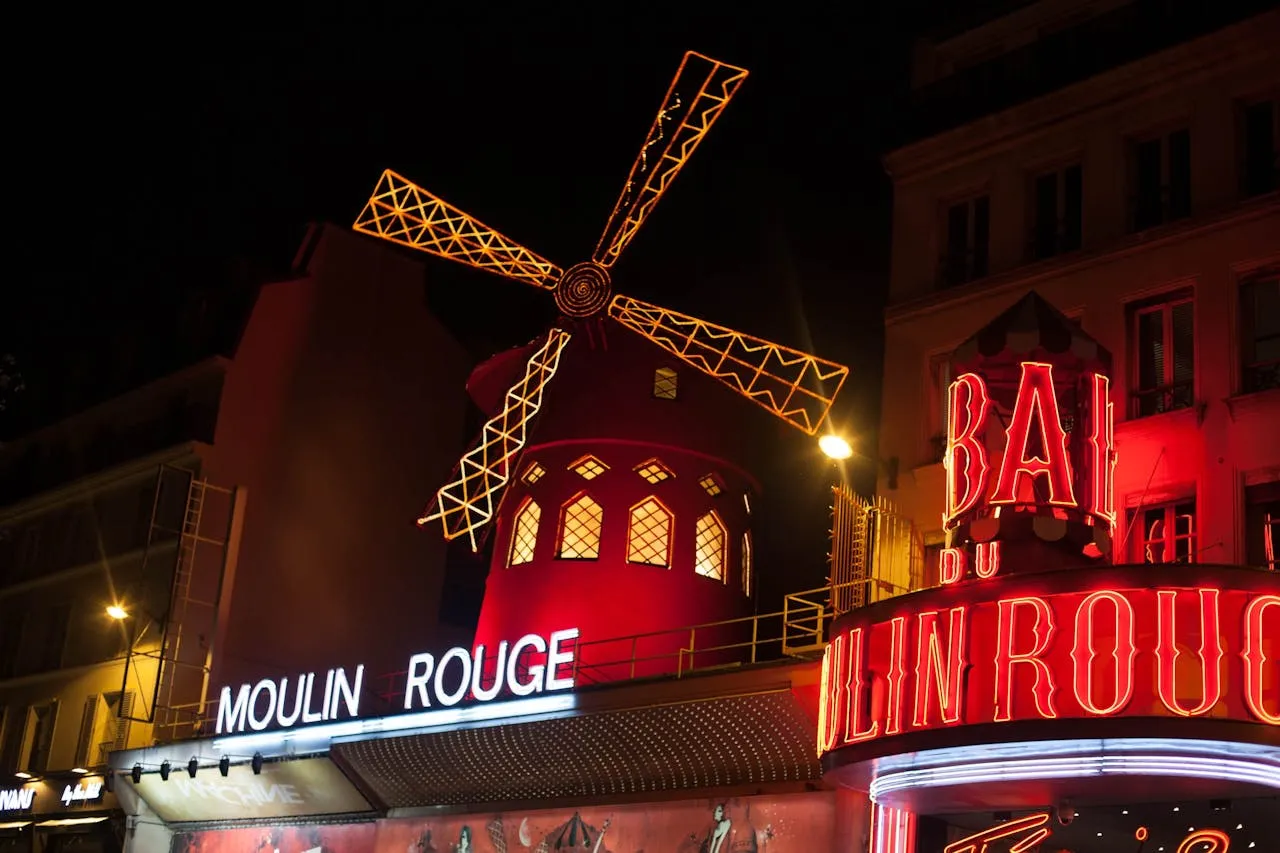
There is a small red windmill turning above a corner of Montmartre that has become one of the most photographed, most mythologized, and most misunderstood landmarks in the world. Long before Instagram, before Baz Luhrmann’s technicolor film, and even before the Eiffel Tower had celebrated its first birthday, this windmill was already spinning above a stage that would change nightlife forever. So, what is Moulin Rouge Paris, exactly? Is it a nightclub, a theatre, a museum piece, or something else entirely? The honest answer is that it is all of these things at once – a living piece of French history that still puts on two or three sold-out shows every single night of the year.
This guide takes a deep, honest look at the Moulin Rouge Paris: where it came from, what happens inside its red walls today, who has danced, sung, and scandalized audiences on its stage, and everything you need to know if you are planning to see it for yourself. Whether you are a curious traveler, a history lover, or someone who just watched the 2001 film and wants to know how much of it is real, by the end of this article you will understand exactly what the Moulin Rouge Paris is – and why it has never gone out of fashion.
What Is Moulin Rouge Paris? A Quick Answer
At its core, the Moulin Rouge Paris is a cabaret music hall located at 82 Boulevard de Clichy, in the Pigalle district of Paris’s 18th arrondissement, right at the foot of Montmartre. It opened its doors on October 6, 1889, and has operated almost continuously ever since, surviving a devastating fire, two world wars, near-bankruptcy, and even the collapse of its own iconic windmill sails in 2024.
Today, the Moulin Rouge is best known for its resident revue, “Féerie,” a spectacular variety show combining the traditional French Cancan with acrobatics, aerial acts, elaborate feathered costumes, and live orchestration. It is not a nightclub you wander into – it is a fully staged, reservation-only production watched by roughly 600,000 people every year, seated at tables for a champagne show or a full dinner-and-show experience. In short, the Moulin Rouge is part historic monument, part world-class theatrical production, and part symbol of French joie de vivre.
The Birth of a Legend: 1889 and the Belle Époque
To really understand what the Moulin Rouge is, you have to go back to the Paris of 1889 – the same year the Eiffel Tower was unveiled for the World’s Fair. The city was in the middle of the Belle Époque, an era defined by optimism, artistic experimentation, and a booming nightlife culture. Into this atmosphere stepped two entrepreneurs, Joseph Oller and Charles Zidler, who had a bold idea: build a pleasure palace at the foot of Montmartre that would blend music, dance, and spectacle in a way Paris had never seen.
They nicknamed their creation “Le Premier Palais des Femmes” – the First Palace of Women – and gave it a name that would become instantly recognizable around the globe: the Moulin Rouge Paris, French for “Red Windmill.” The building’s crowning feature, a bright red windmill mounted on the roof, was a nod to Montmartre’s history as a hilltop dotted with real flour mills, but reimagined as something theatrical, almost surreal. Inside, guests found a vast dance floor, mirrored walls, elegant galleries, and even a garden with a giant elephant statue where late-night performances took place.
From its very first night, the Moulin Rouge Paris was designed to mix social classes in a way that was unusual for the period – aristocrats, artists, and working-class Parisians all rubbed shoulders on the same dance floor. That democratic, anything-goes spirit is part of why it became a cultural sensation almost overnight.
The Cancan: How a Scandalous Dance Became a National Symbol
If one dance defines the Moulin Rouge, it is the French Cancan. Contrary to popular belief, the cancan was not invented at the Moulin Rouge – it actually originated in London music halls in the early 1860s – but it was at the Moulin Rouge where it was perfected, polished, and turned into the electrifying, high-kicking spectacle the world associates with Parisian nightlife.
In the 1890s, legendary performers like La Goulue (“The Glutton”), Jane Avril, and Valentin le Désossé (“Valentin the Boneless”) became the first true stars of the cancan, drawing crowds who came specifically to see them dance. Their fame was cemented by the painter Henri de Toulouse-Lautrec, who became a fixture at the Moulin Rouge Paris and immortalized its dancers in roughly seventeen paintings and, in 1891, the venue’s first iconic promotional poster. That poster is now considered one of the most important works of Belle Époque graphic art, and it turned the Moulin Rouge into an internationally recognized brand before “branding” was even a concept.
The cancan itself – a fast, high-energy line dance involving high kicks, splits, and skirt-flourishing – was considered risqué for its time. In 1906, a stage kiss between the writer Colette and the Marquise de Morny during a Moulin Rouge performance caused such a scandal that the Chief of Police reportedly threatened to shut the venue down entirely. That controversy, rather than damaging the cabaret’s reputation, only added to its mystique.
Fire, War, and Reinvention
No institution survives 130-plus years without a few brushes with disaster, and the Moulin Rouge Paris has had more than its share.
On February 27, 1915, a fire tore through the original building, destroying much of the structure. Paris was in the middle of the First World War, and rebuilding was slow – the Moulin Rouge did not reopen until 1921, and it took until 1925 for it to be fully restored to its former glory. Remarkably, when the building was rebuilt, it also became one of the first structures in Paris to be fitted with an electrically illuminated façade, making it a genuine technological pioneer as well as a cultural one.
The 1920s brought a new golden age under director Jacques-Charles, who imported American-style dance revues and helped launch the career of Mistinguett, who became known as the “Queen of the Music Hall” and starred in landmark productions like “Ça c’est Paris” in 1926. During the Second World War, the German occupying forces controversially promoted the Moulin Rouge as a must-see Paris attraction for soldiers on leave, a dark chapter that nonetheless kept the venue operating through the war years.
The most significant transformation came after the war, when hotelier Jo France purchased and completely renovated the Moulin Rouge in 1951. In 1955, a professional kitchen was added, creating the now-famous “dinner and show” format that remains central to the Moulin Rouge experience today. This era also saw the venue host an extraordinary range of international stars, including Édith Piaf, Frank Sinatra, Ella Fitzgerald, Marlene Dietrich, Elvis Presley, and even The Beatles.
By the late 1990s, however, the Moulin Rouge was facing serious financial trouble. In 1997, the Clerico family – who still run the cabaret today – invested roughly €8 million to develop an entirely new resident show. The result, launched in 1999, was “Féerie,” the production that still fills the Moulin Rouge’s seats every single night, more than a quarter-century later.
In a strange twist of modern history, the Moulin Rouge made global headlines again on April 25, 2024, when the four sails of its rooftop windmill collapsed onto the boulevard below in the middle of the night. Parisians and fans worldwide watched anxiously as restoration crews raced against the clock, and the windmill was fully repaired and spinning again by July 5, 2024 – just in time for the Paris 2024 Olympic torch relay to pass right by its door.
Inside “Féerie”: What the Show Actually Looks Like Today
So what actually happens when you walk through the Moulin Rouge’s doors tonight? The resident show, Féerie, is a full-scale theatrical production, not a simple cabaret act. It took the production team two full years to design and rehearse, and it has been running continuously since the turn of the millennium.
The show unfolds across four spectacular acts, taking the audience on a journey through wildly different worlds: the gardens of the original Moulin Rouge, a pirate adventure set in Indonesia, a dazzling circus sequence, and a tour through Parisian history from 1900 to the present day. Along the way, the audience is treated to acrobats, jugglers, clowns, contortionists, and balancing artists, before the evening builds to its unmissable finale – the French Cancan, performed exactly as thrillingly as it was over a century ago.
The scale of the production is genuinely staggering. Féerie features 80 artists on stage, including 60 “Doriss Girls,” the elite troupe of dancers recruited from around the world through a rigorous audition process. Male dancers are very much part of the company too, despite the venue’s historic reputation as a showcase for women. Every costume is loaded with feathers, rhinestones, and sequins, designed by costumier Corrado Collabucci, and the wardrobe department alone represents an enormous ongoing investment in craftsmanship.
The Astonishing Craftsmanship Behind the Curtain
One of the most fascinating things about the Moulin Rouge is how much old-world artisanship survives behind its modern productions.
The venue’s signature ostrich and marabou feathers have been supplied since 1929 by Maison Février, a specialist feather house that still hand-brushes, washes, boils, and dyes every plume used on stage. The dancers’ cancan skirts are sewn entirely by hand on-site, use roughly 150 meters of fabric each, and can weigh up to five kilograms once Swarovski crystals are added.
Even the shoes are a small miracle of craftsmanship. Made by Maison Clairvoy, a shoemaker that has supplied the Moulin Rouge since 1945, each pair takes between twenty and sixty hours of work and passes through the hands of five different cobblers across roughly 250 individual production steps – because a shoe that has to survive nightly high kicks needs to be built like a piece of engineering, not just a costume accessory.
There is even a naming tradition behind the shows themselves. After the runaway success of the 1957 revue “Frou-Frou,” the Moulin Rouge decided that every subsequent production would begin with the letter F – a superstition that has held for nine consecutive shows, right up to today’s Féerie.
By the Numbers: Facts That Show the Scale of the Operation
To really grasp what the Moulin Rouge is today, it helps to look at the sheer scale of its nightly operation:
- The Moulin Rouge employs around 1,500 people in total, including the 80 on-stage artists, 60 Doriss Girls, and roughly 120 front-of-house staff.
- On a typical night, the venue serves up to 900 guests across its various shows, with around 500 of them enjoying the full dinner service prepared by executive chef Arnaud Demerville and a kitchen brigade of 25 cooks.
- Roughly 50 percent of the audience on any given night is actually French, disproving the assumption that the Moulin Rouge is purely a tourist trap.
- The Moulin Rouge is one of Europe’s single largest retail consumers of champagne, serving an estimated 240,000 bottles every year.
- In 2014, Moulin Rouge dancer Adonis Kosmadakis set a Guinness World Record with 30 leg lifts in 30 seconds, and the venue’s chorus line separately set a record with 720 simultaneous high kicks performed in just 30 seconds.
- Queen Elizabeth II attended a private performance in November 1981, an event significant enough that the cabaret closed its doors to the public for that single evening.
The Stars Who Made – and Were Made By – the Moulin Rouge Paris
Part of what makes the Moulin Rouge Paris legendary is the sheer roster of talent connected to its stage across more than a century. In its earliest years, dancers like La Goulue and Jane Avril became the first true celebrities of the venue, their fame amplified by Toulouse-Lautrec’s posters and paintings. In the 1920s, Mistinguett reigned as the undisputed queen of Parisian music hall, while later decades brought Josephine Baker, whose performances helped define an entirely new era of the cabaret after the Second World War.
The post-war “dinner and show” era turned the Moulin Rouge Paris into a genuine bucket-list stop for global entertainers, with performers and guests including Frank Sinatra, Ella Fitzgerald, Marlene Dietrich, Dalida, Buster Keaton, Elvis Presley, and The Beatles all associated with the venue at various points. Even today, the Doriss Girls are recruited through international auditions, continuing a tradition of turning talented young dancers from around the world into stars of the Parisian stage.
Moulin Rouge Paris in Pop Culture: The 2001 Film and Beyond
For many people outside France, the phrase “Moulin Rouge” instantly conjures Baz Luhrmann’s 2001 musical film “Moulin Rouge!,” starring Nicole Kidman as the courtesan Satine and Ewan McGregor as the penniless writer Christian. The film premiered at Cannes on May 9, 2001, went on to gross around $179 million worldwide against a $50 million budget, and earned eight Academy Award nominations – winning for Best Art Direction and Best Costume Design – along with three Golden Globe Awards.
While the film’s plot is fictional, it borrows heavily and lovingly from the real history of the cabaret. The character Harold Zidler shares his surname with real co-founder Charles Zidler, Satine’s story echoes the life of can-can dancer Jane Avril, and side characters like Môme Fromage, Le Pétomane, and Le Chocolat are named directly after real performers who once graced the actual Moulin Rouge stage. In fact, the 2001 film was far from the first: at least a dozen films have referenced or dramatized the Moulin Rouge, with the earliest known example dating all the way back to a silent film in 1898 – meaning the cabaret has been captivating filmmakers for as long as cinema itself has existed.
Planning Your Visit: Tickets, Prices, and Practical Tips
If all of this history has convinced you to see the Moulin Rouge in person, here is what you need to know to plan a smooth visit.
Location: The Moulin Rouge is located at 82 Boulevard de Clichy, 75018 Paris, right in the Pigalle neighborhood at the base of Montmartre. The Blanche metro station on Line 2 sits directly outside the entrance, and the area is well served by buses and Vélib’ bike-share stations.
Show times: There are typically three performances each evening – a dinner show around 7:00 PM, and two later champagne shows around 9:00 PM and 11:00 PM. Doors close strictly ten minutes before showtime, so arriving late is not an option.
Ticket prices: Prices vary depending on the package. A show-only ticket without champagne typically starts around €100 per person, while a show with a half-bottle of champagne runs closer to €115. The full dinner-and-show experience, which includes a three-course meal by chef Arnaud Demerville plus champagne and seating closer to the stage, starts from roughly €205 per person. Booking the later, weekday, champagne-only shows is generally the most budget-friendly option.
Dress code: The Moulin Rouge Paris asks guests to dress “smart casual.” Sneakers, shorts, flip-flops, and sportswear are not permitted, so it is worth planning an outfit that matches the elegance of the evening.
Booking advice: Reserve at least a month in advance if possible, since weekend shows can sell out weeks ahead of time, especially during peak tourist season. Arriving thirty minutes early is recommended to get settled and enjoy the best possible seating, and note that photography and video recording are not allowed once the performance begins.
Frequently Asked Questions About the Moulin Rouge Paris
What is Moulin Rouge Paris, in one sentence? The Moulin Rouge is a historic cabaret music hall in Paris’s Pigalle district, famous since 1889 for popularizing the French Cancan and for its current resident show, “Féerie,” which combines dance, acrobatics, and elaborate costumes.
Is the Moulin Rouge Paris a nightclub or a theatre? It functions more like a theatre than a nightclub – guests book seats in advance for a fixed-time, fully staged production rather than walking in for an open dance floor or DJ set.
Do I need to speak French to enjoy the show? No. Féerie is primarily a visual, musical, and dance production, so it is fully enjoyable for international audiences regardless of language.
Is the Moulin Rouge Paris suitable for families? While not explicitly a children’s show, many families do attend; some of the costuming leans glamorous and revealing, so travelers with young children may want to research current content guidance before booking.
Why is the windmill on top red? The red windmill is both a nod to Montmartre’s history as a hill covered in real flour mills and a piece of striking, theatrical branding that has made the venue instantly recognizable worldwide since 1889.
Final Thoughts: Why the Moulin Rouge Paris Still Matters
More than 130 years after Joseph Oller and Charles Zidler first lit up that red windmill above Montmartre, the Moulin Rouge Paris remains one of the rare entertainment venues that has never stopped reinventing itself while staying true to its original spirit. It has survived fire, two world wars, financial collapse, and even the literal collapse of its own rooftop windmill – and every single night, it still fills a room with music, feathers, champagne, and the same electric energy that captivated Belle Époque Paris in 1889.
So the next time someone asks you what the Moulin Rouge Paris really is, you will know it is far more than a pretty red windmill on a postcard. It is a living theatre, a museum of craftsmanship, a launchpad for legendary performers, and one of the last places in the world where you can watch history dance the cancan in real time.