

Place De La Nation
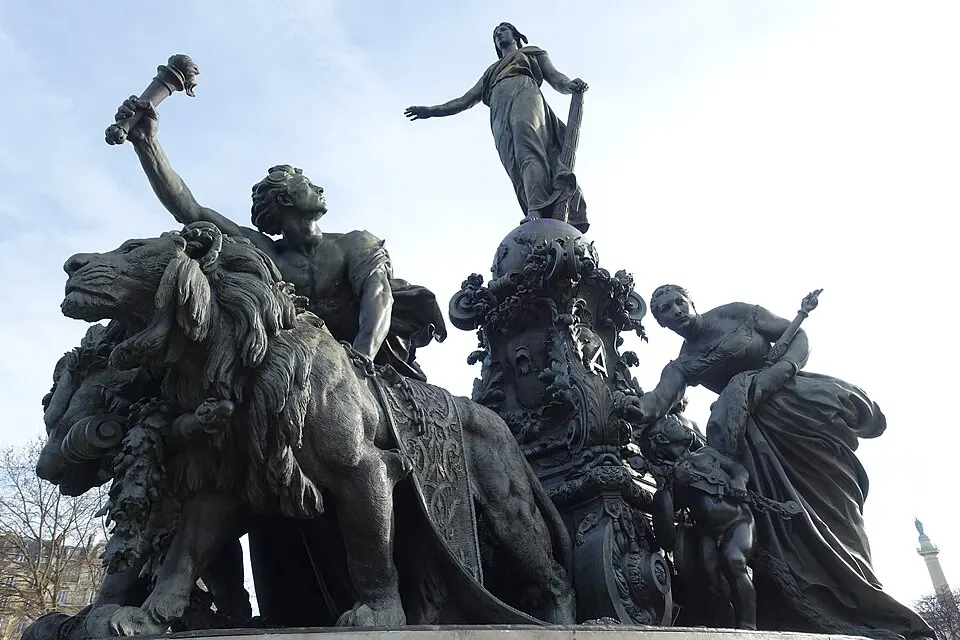
If you want to understand the heartbeat of Paris – its rebellions, its heartbreaks, its celebrations, and its unshakable love of liberty – you don’t need to fight the crowds at the Eiffel Tower or the Louvre. You need to stand quietly in the middle of Place De La Nation, look up at the bronze woman riding a lion-drawn chariot above your head, and let three and a half centuries of history wash over you.
Place De La Nation doesn’t get the same postcard fame as Place de la Concorde or Place des Vosges, and that is exactly what makes it so special. This is a square built by Parisians, for Parisians – a place where kings once processed in triumph, where revolutionaries once trembled beneath the guillotine, where teenagers once screamed for their pop idols, and where, today, families push strollers past flower beds on a quiet Sunday morning. Few places in this city carry so much raw, human emotion in such a small circle of pavement.
In this guide, we’ll walk you through the complete story of Place De La Nation – its royal origins, its revolutionary darkness, its cultural rebirth, and everything you need to know to visit it yourself. By the end, you’ll understand why so many travelers who stumble upon Place De La Nation say it left a deeper impression on them than almost anywhere else in Paris.
Where Is Place De La Nation?
Place De La Nation sits on the eastern edge of Paris, straddling the border between the 11th and 12th arrondissements, roughly halfway between the Place de la Bastille and the vast green expanse of the Bois de Vincennes. It functions today as a large traffic circle and pedestrian square, anchored by a dramatic bronze monument at its center and ringed by cafés, brasseries, and Haussmann-era apartment buildings.
Because it sits slightly outside the tourist-heavy core of central Paris, Place De La Nation feels more like a living neighborhood square than a monument built for visitors. That authenticity is part of its charm – you’ll see locals walking their dogs, students meeting for coffee, and elderly Parisians reading newspapers on benches beneath the plane trees, all in the shadow of one of the most emotionally powerful sculptures in the entire city.
A Throne Fit for a King: The Birth of the Square (1660)
The story of Place De La Nation begins not with revolution, but with romance and royal pageantry. On 26 August 1660, a magnificent ceremonial procession entered Paris to celebrate the marriage of King Louis XIV to Maria Theresa of Spain, who had wed weeks earlier in Saint-Jean-de-Luz. To mark the occasion, an ornate throne was erected on what was then open, grassy land just outside the city’s edges, and the young king and his bride passed through in triumph.
That temporary throne left a permanent linguistic mark. The area became known as the Place du Trône – “Throne Square” – a name so deeply embedded in the local geography that it survives today in the nearby Avenue du Trône and Cours de Vincennes. At the time, this wasn’t even considered “Paris” in the way we think of it now; it was countryside beyond the city walls, dotted with vineyards, market gardens, and the grounds of religious convents in the old village of Picpus.
A few years later, King Louis XIV’s finance minister, Jean-Baptiste Colbert, dreamed even bigger. He commissioned a grand architectural competition for a monumental triumphal arch to stand on the Place du Trône, a four-pillared structure designed by the celebrated architect Claude Perrault. Construction began in the 1670s, with the foundations and lower stonework rising in high-quality stone. But ambition outran funding. Around 1680 the project stalled, and by 1716 – just after Louis XIV’s death – the unfinished structure was demolished entirely. Even in failure, the arch left its mark on French cultural history: the debate over its inscriptions sparked a public controversy known as the “Quarrel of Inscriptions,” an early skirmish in the intellectual battles that would eventually fuel the Enlightenment.
The Tax Wall and the Twin Columns
By the 1780s, Paris needed money, and the monarchy’s answer was a new customs wall. Between 1784 and 1791, the Wall of the Farmers-General (Mur des Fermiers Généraux) was built to encircle the city, allowing tax collectors to charge duties on goods entering Paris. At the Place du Trône, this wall took a monumental form: two elegant single-story customs pavilions and two soaring 60-meter-high columns, all designed by the visionary architect Claude-Nicolas Ledoux.
These twin columns, known as the Colonnes de la Barrière du Trône, still stand today – one of the few surviving fragments of Ledoux’s original vision for Paris. In 1845, statues of two medieval French kings, Philip II and Louis IX, were placed atop the columns, where they remain visible to visitors walking through the square. The pavilions themselves were officially listed as historical monuments in 1907, and they mark the southern edge of Place De La Nation to this day – quiet stone witnesses to everything that has unfolded around them.
The Darkest Chapter: The Guillotine of 1794
No honest account of Place De La Nation can skip over its most harrowing period. When the French Revolution erupted and the monarchy collapsed in 1792, the square’s name was defiantly rewritten: it became the Place du Trône-Renversé, the “Square of the Overturned Throne” – a direct, symbolic rejection of the royal ceremony that had given the space its original identity.
Then came the Reign of Terror. In June 1794, following the passage of the Law of 22 Prairial – a law that stripped defendants of legal protection and dramatically accelerated revolutionary trials – the guillotine was relocated to the shaded southern side of the square, near Ledoux’s pavilion. What followed was one of the bloodiest chapters of the entire Revolution. Between 13 June and 27 July 1794, in a period of just over six weeks, more than 1,300 people were executed here, at times averaging around 30 deaths a day. The victims came from every layer of society: aristocrats, priests, poets, composers, and ordinary citizens swept up in revolutionary paranoia.
Among those who died on this ground was the celebrated poet André Chénier, executed on 25 July 1794 – just two days before the fall of Robespierre finally brought the killing to a halt. The Carmelite nuns later remembered as the Martyrs of Compiègne were executed here as well, an event so haunting it later inspired an opera. The bodies of those guillotined were carried to a mass grave in the nearby Picpus Cemetery, which still exists today as one of the most solemn, lesser-visited memorial sites in Paris.
It’s a sobering thought to stand in the same spot today, surrounded by flower beds, café terraces, and the hum of traffic, and to know that this ground once ran with so much grief. That contrast – beauty layered over trauma – is part of what gives Place De La Nation its unusual emotional weight.
From Trône Back to Nation: A New Name for a New Republic
After the fall of Robespierre, the square reverted to its old royal name, Place du Trône, and it kept that name through Napoleon’s reign and the restorations of the monarchy in 1814 and 1815. It wasn’t until the Third Republic that the square finally received the identity we know today.
On 14 July 1880 – Bastille Day – the square was officially renamed Place de la Nation. This wasn’t a coincidence of timing. That same year, the Third Republic made it obligatory for the phrase Liberté, Égalité, Fraternité to be inscribed on all French public buildings, cementing the republican values the new name was meant to represent. After a century of revolution, empire, and restoration, Paris finally gave this scarred ground a name that spoke not of kings, but of the people themselves – the Nation.
The Triumph of the Republic: Marianne’s Bronze Glory
If Place De La Nation has a soul, it lives in the towering bronze monument at its center: The Triumph of the Republic (Le Triomphe de la République), created by the sculptor Aimé-Jules Dalou.
Dalou, a former Communard who had spent years in exile in London before returning to France in 1879, originally designed the sculpture for a competition intended for Place de la République. Though it didn’t win that commission, the design found its true home here instead. A plaster version was unveiled in 1889 to mark the centenary of the French Revolution, and the completed bronze monument was formally inaugurated a decade later, in 1899.
The sculpture is breathtaking in both scale and symbolism. At its center stands Marianne, the eternal personification of the French Republic, standing triumphantly atop a globe within a chariot pulled by two powerful lions. She is surrounded by allegorical figures representing Liberty, Labor, Justice, and Abundance – the pillars on which the Republic was meant to stand. Crucially, Marianne’s gaze is fixed toward the Place de la Bastille, along the historic Rue du Faubourg-Saint-Antoine – a deliberate visual link to the birthplace of the Revolution itself, tying this square forever to the events that shaped modern France.
When the monument was first installed, it stood at the center of a large decorative pond, complete with sea-monster sculptures by Georges Gardet – fearsome, crocodile-like creatures meant to symbolize the reactionary forces the Republic had triumphed over. Tragically, these bronze creatures were melted down by German occupying forces during World War II, and the pond itself was eventually removed and paved over in 1960 during the construction of a new RER commuter rail line running beneath the square. Today, only Dalou’s central masterpiece remains, rising proudly from the heart of the roundabout, still watching over the city it was built to celebrate.
A Stage for Protest, Passion, and Pop Culture
What makes Place De La Nation so uniquely alive is that its story didn’t end in the 19th century. This square has continued to be a stage for some of the most defining moments of modern French history – both joyful and painful.
A tragic day in 1953. On 14 July 1953, a march for Algerian independence, organized by the MTLD movement, proceeded from Place de la République to Place de la Nation. As demonstrators gathered to pack up their placards, Paris police opened fire on the crowd. Six Algerians and one French union worker were killed, and 126 people were wounded. No formal inquiry was ever held into the shooting. A modest plaque on one of Ledoux’s old customs pavilions today quietly commemorates the victims – an easy detail to miss, but an important one to seek out.
The birth of French youth culture. On a much lighter note, Place De La Nation became the site of a cultural earthquake on 22 June 1963, when the magazine Salut les copains organized a massive open-air concert featuring the biggest pop stars of the era: Johnny Hallyday, Richard Anthony, Eddy Mitchell, and Frank Alamo. More than 150,000 young people flooded the square, and newspaper headlines the next day captured the shock of an older generation with lines like “Salut les voyous!” (“Hello, hooligans!”). It’s widely remembered as one of the defining moments in the emergence of modern French youth and pop culture.
A gathering place for the Republic. Because of its symbolic name and its proximity to Place de la Bastille and Place de la République, Place De La Nation has remained one of the traditional endpoints for major political demonstrations and Bastille Day marches, from Popular Front rallies in the 1930s to modern-day labor protests. It remains, in a very real sense, a living political square – not a museum piece, but a place where the Republic’s ideals continue to be tested and voiced.
The Foire du Trône. On a happier note, for centuries the square hosted the beloved Foire du Trône, a massive traveling funfair filled with rides, games, and food stalls – one of the oldest and largest fairs in France, with roots stretching back nearly a thousand years to a medieval gingerbread market. The fair remained on Place De La Nation until 1964, when it moved a short distance away to the nearby Pelouse de Reuilly, where it continues to be held every spring.
A Modern Makeover: The Green Transformation
For much of the 20th century, Place De La Nation functioned primarily as a chaotic traffic roundabout, with cars circling the monument on a wide ring road. That changed dramatically in recent years, when the City of Paris – under then-Mayor Anne Hidalgo – undertook a major redesign of the square as part of a broader push to reduce car dependency and green the capital.
The transformation reduced the diameter of the central traffic ring from 26 meters down to just 12 meters, dramatically shrinking the space given to cars and expanding the space given to people. Wide pedestrian plazas, protected bike lanes, and lush new garden beds now surround Dalou’s monument, inviting visitors to actually linger in the square rather than simply pass through it. What was once primarily a traffic obstacle has become, once again, a genuine public gathering space – a garden square in the truest sense, shaped by input from the residents of the 11th and 12th arrondissements who call this corner of Paris home.
What to See at Place De La Nation Today
When you visit Place De La Nation, take your time and look for these highlights:
- The Triumph of the Republic monument – Dalou’s masterpiece, best appreciated from multiple angles as you circle the garden. Look closely at the allegorical figures surrounding Marianne.
- The Colonnes de la Barrière du Trône – Ledoux’s twin 18th-century columns, crowned with statues of medieval French kings, standing at the square’s southern edge.
- The old customs pavilions – modest stone buildings that once collected taxes on goods entering Paris, now protected historical monuments, and home to the memorial plaque for the victims of the 1953 shooting.
- The garden and pedestrian plaza – the newly redesigned green heart of the square, ideal for a quiet break with a coffee or a picnic.
The surrounding Faubourg Saint-Antoine neighborhood – historically the center of Parisian cabinetmaking and furniture craftsmanship, and still full of character today.
How to Get to Place De La Nation
One of the great advantages of Place De La Nation is how effortlessly connected it is to the rest of Paris.
- Metro: Nation station serves lines 1, 2, 6, and 9, making it one of the best-connected transit hubs on the eastern side of the city.
- RER: Line A also stops directly at Nation, offering a fast connection toward La Défense, Disneyland Paris, and the wider Île-de-France region.
- Bus: Multiple bus lines converge here, including routes 26, 29, 56, 57, 86, and 351, plus night bus service for late-evening travelers.
- Bike: Dedicated bike lanes now lead directly into the square, and Vélib’ bike-share stations are available nearby for visitors who want to explore the surrounding neighborhoods on two wheels.
Because of this connectivity, Place De La Nation makes an excellent base for exploring eastern Paris, including the Bois de Vincennes, the Picpus Cemetery, the Bastille neighborhood, and the atmospheric streets of the Faubourg Saint-Antoine.
Nearby Attractions Worth Combining With Your Visit
If you’re planning a day around Place De La Nation, consider pairing it with:
Picpus Cemetery, a short walk away, holding the mass grave of those executed here during the Terror, alongside the tomb of the Marquis de Lafayette.
Bois de Vincennes, Paris’s largest public park, complete with a zoo, a château, a lake, and wide green spaces perfect for escaping the city bustle.
Place de la Bastille, connected by the historic Rue du Faubourg-Saint-Antoine, letting you walk in the literal footsteps of revolutionary marches.
Coulée Verte René-Dumont (the Promenade Plantée), an elevated garden walkway built atop an old railway viaduct, offering one of the most peaceful strolls in Paris.
Practical Tips for Visiting
- Best time to visit: Early morning or late afternoon, when the light catches the bronze of the monument beautifully and the square is at its quietest.
- Photography: The best angle of the Triumph of the Republic is from the Faubourg Saint-Antoine side, where you can see Marianne’s gaze directed toward the Bastille.
- Duration: Plan for 30–45 minutes to properly explore the monument, columns, and gardens, or longer if you’re combining it with a walk through the surrounding neighborhood.
- Accessibility: The redesigned pedestrian plazas make the square much easier to navigate on foot than in years past, with wide, level pathways around the central garden.
- Cafés nearby: The square is ringed with brasseries and cafés perfect for people-watching after your visit.
Why Place De La Nation Deserves a Place on Your Paris Itinerary
Most visitors to Paris rush past Place De La Nation on their way to somewhere else, glimpsing the bronze monument through a taxi window or a metro exit without ever really stopping to look. That’s a shame, because few squares in this city hold so much layered, textured history in such a compact space. Here, in one roundabout, you’ll find royal ceremony, revolutionary terror, republican triumph, wartime loss, teenage euphoria, and modern civic renewal – all folded into the same few hundred meters of Parisian ground.
Place De La Nation isn’t trying to be a postcard. It’s something better: a living, breathing piece of the city’s memory, still shaping the neighborhood around it every single day. Next time you’re planning your Paris itinerary, give this remarkable square the time it deserves. Stand beneath Marianne’s bronze chariot, read the quiet plaque on the old customs pavilion, and let the layered emotional weight of Place De La Nation remind you why Paris has captivated the world for centuries – not because it is perfect, but because it remembers everything, and keeps moving forward anyway.