

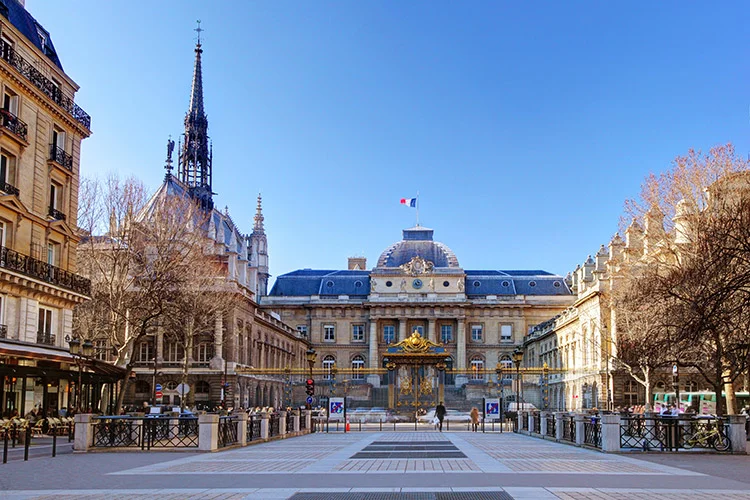
A thousand years of royal power, revolutionary terror, and living justice – all behind one extraordinary set of golden gates on the Île de la Cité.
The Palace of Justice Paris – the Palais de Justice – is one of those rare places where every stone tells a story. Standing on the Île de la Cité, the ancient island heart of Paris, this monumental complex has been a royal residence, a Revolutionary prison, and a living courthouse for over a thousand years. To visit it is to walk through the entire sweep of French history in a single afternoon.
Most visitors come to the Île de la Cité for Notre-Dame Cathedral, and rightly so. But right at the opposite end of the island stands an equally astonishing – and far less crowded – collection of monuments: the soaring Gothic Sainte-Chapelle, the haunting medieval halls of the Conciergerie, and the grand neoclassical facade of the Palais de Justice itself. Together, they form one of the most compelling historical sites in all of Europe.
This guide covers everything you need to know: the full history, what to see inside, practical visitor tips, and how to book your tickets to make the most of every moment.
A Thousand Years of History: From Royal Palace to Temple of Law
Palace of Justice
Few buildings in the world carry as much layered history as the Palace of Justice Paris. Its story begins not in the Middle Ages, but in Roman times, when a governor’s residence first occupied this island in the Seine. Over the following millennium, it would be rebuilt, expanded, burned, and reborn – each era leaving its own mark on the stone.
4th Century
Roman Emperor Julian the Apostate establishes a residence on the Île de la Cité – the earliest origins of the site.
6th Century
Clovis, founder of the Frankish monarchy, takes up residence here, cementing the island as the centre of French royal power.
10th Century
The Capetian kings – beginning with Hugues Capet – make the Palais de la Cité their principal royal residence, a role it holds for nearly four hundred years.
1242
King Louis IX (Saint Louis) commissions the Sainte-Chapelle to house his extraordinary collection of holy relics from Christ’s Passion. It is consecrated just six years later in 1248.
14th Century
Under Philip the Fair, the palace reaches its grandest form. When Charles V moves the royal court to the Louvre in 1358, the Palais de la Cité transitions into its enduring new role as the seat of French justice.
1793
The Revolutionary Tribunal is established in the Conciergerie. Thousands of prisoners pass through its cells, including Marie-Antoinette, before being sent to the guillotine.
19th Century
Major reconstruction under the Second Empire gives the palace its current neoclassical grandeur: the imposing façade, the gilded gates, and the monumental Cour du Mai courtyard.
Today
The Palais de Justice houses the Court of Appeal of Paris and the Court of Cassation – France’s highest court of appeal – while welcoming visitors to experience its history firsthand.
“From the 10th century onward, the Capetian kings chose the Île de la Cité to house the heart of their government. When the sovereigns abandoned the Cité in favour of the Louvre, they did not abandon the site entirely – they left behind their administrations, and above all, the Parlement de Paris, the kingdom’s highest judicial authority. The monument’s fate was sealed: it would become the temple of law.”
What to See Inside the Palace of Justice Paris
The Palais de Justice complex is far more than a single building. It is a layered world of chapels, medieval halls, grand courtrooms, and ancient courtyards – each with its own extraordinary character. Here is what awaits you.
Hidden behind the walls of the Palace of Justice, the Sainte-Chapelle is one of the greatest architectural achievements of the Middle Ages – and one of the most breathtaking interiors you will ever step inside. Built between 1242 and 1248 at the command of King Louis IX, it was designed not merely as a place of worship but as a giant reliquary: a building conceived to house the king’s extraordinary collection of relics from the Passion of Christ, including what was believed to be the Crown of Thorns.
What makes the Sainte-Chapelle so extraordinary is what the architect – possibly Pierre de Montreuil, whose tombstone read “Doctor in Stonework” – achieved structurally. In a Gothic building, the entire weight of the roof is transferred to external buttresses, allowing the walls in between to dissolve almost entirely into glass. In the upper chapel of the Sainte-Chapelle, this idea is taken to its absolute limit. There are no walls. In their place stand fifteen enormous windows, rising nearly fifteen metres, containing 1,113 scenes depicted in 615 square metres of medieval stained glass – the largest ensemble of 13th-century glass anywhere in the world.
On a sunny day, the upper chapel is almost incomprehensible in its beauty. Deep blues and reds fill the entire space with coloured light, the stone tracery between the windows barely visible. It is, as one writer put it, the very dream of every Gothic architect made real. No photograph fully prepares you for the experience of standing inside it.
✦ Visitor Tip
The Sainte-Chapelle relies entirely on natural light to reveal the full glory of its windows. Visit on a clear morning for the most vivid colours. Overcast days significantly reduce the visual impact. The upper chapel – where the stained glass is – is reached by a narrow staircase from the lower chapel.
The Conciergerie: Where History Turned Dark
Adjacent to the Sainte-Chapelle but utterly different in atmosphere, the Conciergerie tells the shadow side of French history. This medieval fortress its three distinctive towers visible from the Seine began life as the administrative heart of the royal palace. Its great hall, the Salle des Gens d’Armes, built in the 14th century, is the largest surviving Gothic hall in Europe, with sweeping vaulted ceilings and enormous fireplaces that once kept the royal court warm.
When the kings departed for the Louvre, the Conciergerie became a prison – and not just any prison. During the French Revolution, it became the last stop for those condemned by the Revolutionary Tribunal. Between 1793 and 1795, thousands of prisoners were held here before being sent to the guillotine. Among them were some of the most famous figures of the Revolution itself – including, in one of history’s great ironies, Robespierre, the very architect of the Reign of Terror, who ended his days in the same cells he had filled.
Marie-Antoinette’s Final Days
The most poignant room in the Conciergerie is the cell where Marie-Antoinette, Queen of France, spent her final seventy-six days before her execution in October 1793. She arrived stripped of nearly all her belongings, her hair shorn short – a deliberate humiliation. In 1815, after the restoration of the monarchy, her original cell was converted into an expiatory chapel in her memory. Today, visitors can stand in that same space, among the few personal objects that have survived, and feel the full weight of what happened here.
The Palais de Justice Itself: Living History on Your Doorstep
While the Sainte-Chapelle and the Conciergerie are ticketed monuments, the Palais de Justice proper – the working courthouse – is free to enter and open to the public on weekdays. Stepping inside is a genuinely unusual experience. This is no museum; it is a functioning court of law, and the atmosphere makes that clear immediately.
The Cour du Mai, the palace’s ceremonial courtyard, is a wonderful place to begin. Look closely at the exterior walls and you can still make out fleurs-de-lys carved into the stone – ghostly reminders of the royal palace this once was. From the courtyard, visitors enter through the same security checkpoint used by lawyers, magistrates, and defendants, which adds a strangely thrilling note of authenticity.
The Cour du Mai, the palace’s ceremonial courtyard, is a wonderful place to begin. Look closely at the exterior walls and you can still make out fleurs-de-lys carved into the stone – ghostly reminders of the royal palace this once was. From the courtyard, visitors enter through the same security checkpoint used by lawyers, magistrates, and defendants, which adds a strangely thrilling note of authenticity.
Inside, the Salle des Pas-Perdus – the Hall of Lost Footsteps – is one of Paris’s most magnificent and least-known interiors. A vast, double-naved hall commissioned by King Philip the Fair in 1298, it stretches the entire length of the building. Lawyers in black robes pace its length between hearings, their voices echoing under the vaulted ceiling. This space has been the antechamber of French justice for more than seven hundred years.
If you are lucky, you may be able to sit in on a public hearing in one of the active courtrooms – dark wood panelling, golden ceilings, the choreography of lawyers and judges playing out exactly as it has for centuries. French law requires that justice be administered in public, so courtrooms are open to respectful visitors. No photography is permitted inside, but the experience is one few travellers expect to find in Paris.
✦ Hidden Gem
As you leave the Palace of Justice, walk around the corner to 36 Quai des Orfèvres. For over a century, this imposing building was home to the Direction régionale de la police judiciaire – Paris’s equivalent of Scotland Yard – made famous worldwide by the fictional detective Commissaire Maigret in Georges Simenon’s beloved novels.
Essential Visitor Information
Address
10 Boulevard du Palais
75001 Paris, Île de la Cité
Nearest Metro
Cité – Line 4
Also: Châtelet (Lines 1, 4, 7, 11, 14)
Sainte-Chapelle & Conciergerie Hours
9:30 AM – 6:00 PM daily
Last admission 5:30 PM. Closed Jan 1, May 1, Dec 25
Palais de Justice (Courthouse)
Mon–Fri, 9:00 AM – 6:00 PM
Free entry. Closed weekends & public holidays
Security
Airport-level checks
No knives, tools or sharp objects. Empty your pockets
Insider Tips for the Perfect Visit
Book your Sainte-Chapelle tickets online before you arrive. The chapel sells a limited number of timed-entry tickets. During summer, these can sell out days in advance. Online booking also lets you skip the sometimes lengthy security queue.
Visit the Conciergerie first, then proceed to the Sainte-Chapelle. There is usually a shorter queue for the Conciergerie. Buying a combined ticket there lets you proceed directly to the Sainte-Chapelle entrance, bypassing the main queue.
Choose a sunny day for the Sainte-Chapelle. The entire experience of the stained-glass windows depends on natural light. A grey Paris morning turns the chapel dark and muted; a bright day makes it transcendent.
Arrive early. The Sainte-Chapelle opens at 9:30 AM. The first hour of the day offers the fewest crowds and the most peaceful atmosphere in which to take in the windows.
Come prepared for strict security. The Palace of Justice is a working court of law. Security is more rigorous than at most Paris monuments – no knives, tools, or sharp objects of any kind. Plan ahead to avoid abandoning belongings at the entrance.
Book a guided tour for the full story. The history layered inside the Palace of Justice complex is extraordinarily rich. A knowledgeable guide brings it to life – connecting the Capetian kings, the Revolutionary Tribunal, the Dreyfus Affair, and the living legal system of today in a way no audio guide can match.
Combine with Place Dauphine. Right behind the Palace of Justice is one of Paris’s most perfectly preserved 17th-century squares. After the intensity of the Conciergerie, it is a wonderful place to find a table at a café and let the afternoon settle around you.
Dress and behave respectfully inside the courthouse. You are entering an active institution of state. No photography in courtrooms. Keep your voice low and your phone silent. It is a rare privilege – treat it as such.
Historic Trials That Shook France
The Palace of Justice Paris has been the stage for some of the most consequential legal proceedings in French – and European – history. Understanding these stories transforms a visit from a sightseeing experience into something far deeper.
The Revolutionary Tribunal (1793–1795)
Between 1793 and 1795, the Revolutionary Tribunal operated from the Conciergerie and sent over 2,700 people to their deaths, including Marie-Antoinette, the poet André Chénier, and ultimately Robespierre himself. The records of these proceedings – preserved in the archives of the Palais de Justice – remain among the most chilling documents in French history.
The Dreyfus Affair (1894 & 1899)
In the late 19th century, the Palace of Justice was the setting for two trials of Captain Alfred Dreyfus, a Jewish officer in the French army wrongfully convicted of treason. The affair divided France for over a decade, provoked the birth of modern political Zionism, and ultimately became a defining moment in the history of human rights. Dreyfus was eventually fully exonerated, but not before the trials had exposed deep currents of anti-Semitism within French institutions.
The November 2015 Paris Attacks Trial
More recently, the Palais de Justice hosted one of the longest and most complex criminal trials in French history: the proceedings arising from the November 2015 terrorist attacks in Paris that killed 130 people. The trial, which concluded in 2022, demonstrated that this building remains at the very heart of how France confronts its darkest moments – and how a society processes collective trauma through the structures of law.
What to See Nearby
The Palace of Justice sits in one of the richest concentrations of historic monuments anywhere in Paris. A single day on the Île de la Cité and its immediate surroundings can take in an extraordinary range of experiences.
Notre-Dame Cathedral stands at the eastern tip of the island, barely a ten-minute walk from the palace entrance. Having undergone a remarkable restoration after the 2019 fire, it reopened its doors to visitors in December 2024 and is once again one of the most awe-inspiring Gothic interiors in Europe.
Place Dauphine, tucked immediately behind the Palace of Justice, is one of the most quietly beautiful squares in Paris. Built in the early 17th century at the order of King Henri IV, its triangular form and red-brick facades feel almost impossibly serene given their location at the very centre of the city.
Pont Neuf, despite its name – “New Bridge” – is actually the oldest standing bridge in Paris, completed in 1607. Its arches offer some of the finest views of the Seine in the city, and the small park at its tip, the Square du Vert-Galant, is one of Paris’s hidden green sanctuaries.
Frequently Asked Questions
Is the Palace of Justice Paris free to visit?
The Palais de Justice courthouse itself is free to enter and open to the public on weekdays. The Sainte-Chapelle and the Conciergerie charge separate admission fees – booking online in advance is strongly recommended, especially in summer, to secure your entry slot and save time.
What are the opening hours of the Palace of Justice Paris?
The Palais de Justice courthouse is open Monday to Friday, from 9:00 AM to 6:00 PM. The Sainte-Chapelle and the Conciergerie are open daily from 9:30 AM to 6:00 PM (last admission at 5:30 PM). All three are closed on January 1, May 1, and December 25.
Can you attend a court hearing at the Palace of Justice Paris?
Yes. French law requires justice to be administered publicly, so courtroom hearings are open to respectful visitors. Photography is strictly forbidden inside the courtrooms, and a calm, formal demeanour is expected. It is a genuinely rare experience – seeing the French legal system at work in a setting that has barely changed in two centuries.
How do I get to the Palace of Justice Paris?
The most direct route is the Métro Cité station on Line 4, which deposits you directly in front of the palace entrance. You can also walk from Châtelet (Lines 1, 4, 7, 11 and 14) in around ten minutes along the riverbank. Bus lines 21, 27, 72, 85 and 86 all serve the Île de la Cité.
Is it worth booking a guided tour of the Palace of Justice Paris?
Absolutely. The history layered within the Palais de Justice complex spans more than a thousand years and intersects with some of the most dramatic moments in French history. A guide who can connect the threads – from Saint Louis commissioning the Sainte-Chapelle to Marie-Antoinette in her cell to today’s Court of Cassation – transforms a remarkable visit into an unforgettable one.
What is inside the Palace of Justice Paris?
The complex contains the Sainte-Chapelle (a Gothic chapel with 1,113 medieval stained-glass windows), the Conciergerie (a medieval hall and Revolutionary prison, including Marie-Antoinette’s cell), the Salle des Pas-Perdus, the Cour du Mai courtyard, and the active courtrooms of the Court of Appeal and the Court of Cassation.
Ready to Experience the Palace of Justice Paris?
Book your guided tour, Sainte-Chapelle tickets, or Conciergerie entry safely online – skip the queues and arrive ready to be inspired.